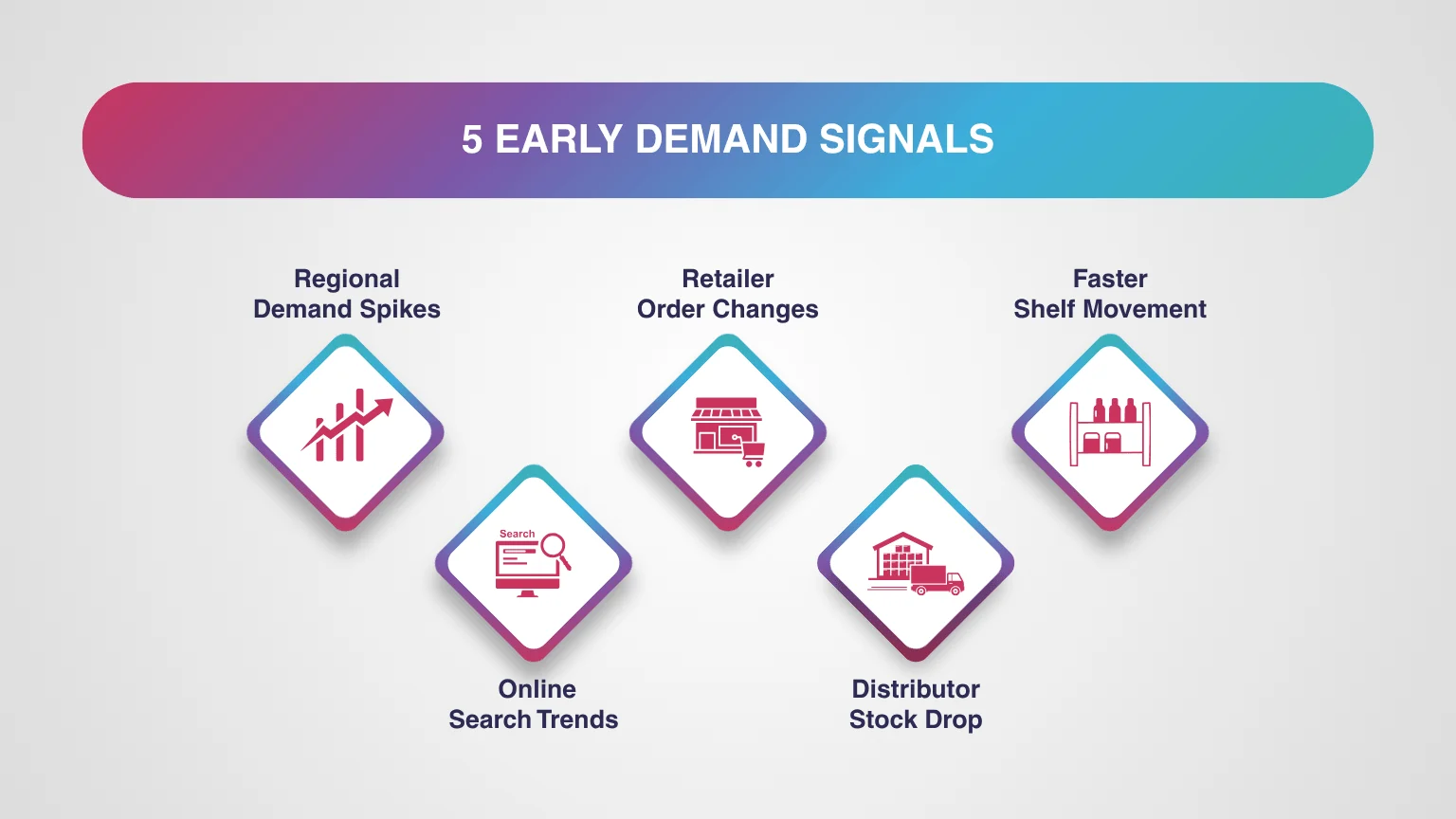
5 Early Demand Signals FMCG Teams Miss Before Stockouts Hit

Stockouts rarely happen overnight. They build up quietly hidden in patterns most teams don’t notice until it’s too late. By the time shelves are empty, the damage is already done. Customers switch brands, and in many cases, they don’t come back. In fact, more than 70% of shoppers are likely to choose an alternative when their preferred product is unavailable.

What separates high-performing FMCG teams isn’t how they react to stockouts, but how early they detect demand shifts. Strong stockout prevention starts with identifying these subtle signals before they escalate.
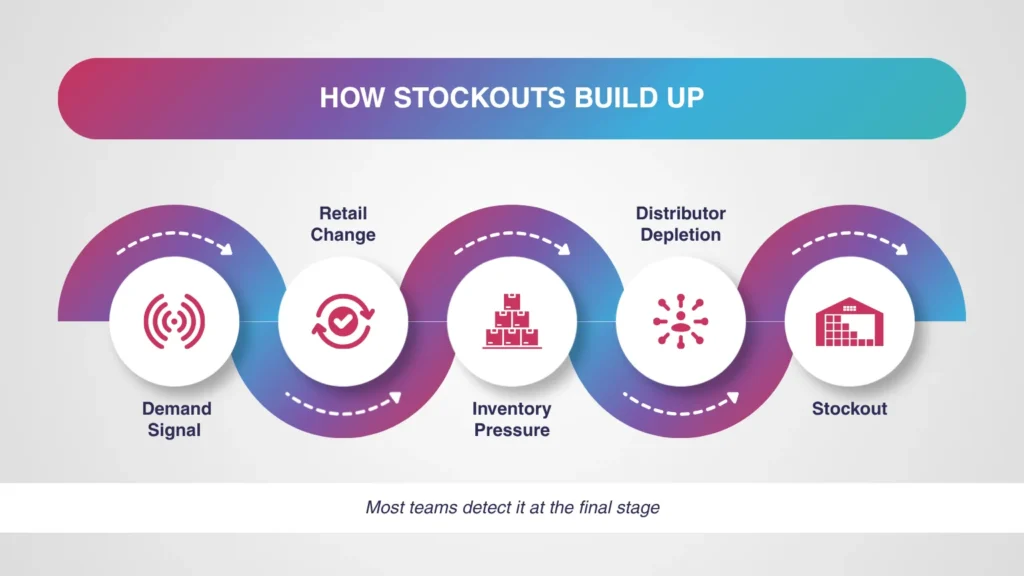
How demand signals lead to stockouts

1. Regional demand spikes that get lost in averages

Demand rarely grows evenly across markets. A sudden spike in one city driven by weather, local events, or even a competitor running out of stock can quietly build into a larger supply issue. The problem is that most reporting systems average demand at a national level, which hides these early shifts.

Companies that break demand down regionally often see a noticeable improvement in forecast accuracy, sometimes by as much as 20%. That difference can be the line between staying in stock and missing sales opportunities.

When teams start paying closer attention to these localized patterns, stockout prevention becomes less about reacting late and more about acting early.

2. Subtle changes in how retailers place orders

Retailers are often the first to sense demand changes because they are closest to the end customer. When demand begins to rise, it doesn’t always show up as larger orders. Instead, it appears as more frequent orders, smaller quantities placed repeatedly, or even urgent replenishment requests.

These shifts are easy to miss if the focus stays on total order volume rather than ordering behavior. Businesses that invest in better inventory management systems tend to catch these patterns earlier and, as a result, significantly reduce stockouts – sometimes by around 30%.

Over time, it becomes clear that retailers are constantly signaling what’s happening on the ground. The real challenge is building systems that actually listen.

3. Faster movement of products at the shelf

One of the clearest indicators of rising demand is how quickly products move off the shelf. When inventory starts turning faster than usual, the number of days a product stays available drops—and that’s often where early warnings begin.

Many teams still rely heavily on warehouse-level data, which doesn’t always reflect what’s happening at the point of sale. Strong demand planning shifts the focus toward sell-through rates and real-time movement.

Organizations that refine their demand planning processes not only reduce excess inventory but also improve product availability, often lowering overall inventory costs by a meaningful margin while maintaining better service levels.

Watching how fast products sell, rather than how much stock exists, changes the way teams respond to demand.

4. Online behavior that signals demand before it happens

Consumer intent often shows up online before it translates into actual purchases. Search trends, product page visits, and social media engagement can all indicate that demand is about to increase.

For example, a sudden rise in searches for healthier snack options or energy drinks can quickly translate into higher store demand. What’s interesting is that these digital signals often appear weeks in advance, giving teams a valuable window to act.

Modern FMCG demand forecasting is evolving to include these signals, moving beyond traditional historical models. When digital behavior is integrated into FMCG demand forecasting, teams gain a much clearer view of what’s coming next rather than what has already happened.

5. Distributor stock that starts depleting faster

Distributors sit at a critical point in the supply chain, yet their data is often underutilized. When their stock begins to deplete faster than usual, it’s usually because retail demand has already picked up.

By the time this information reaches central systems, it’s often delayed or diluted. However, companies that actively monitor distributor-level movement are better positioned to respond quickly and reduce stockouts before they escalate.

In many cases, improving visibility at this level has helped organizations strengthen their stockout prevention efforts significantly, simply because they are no longer reacting too late.

Why these signals are still missed
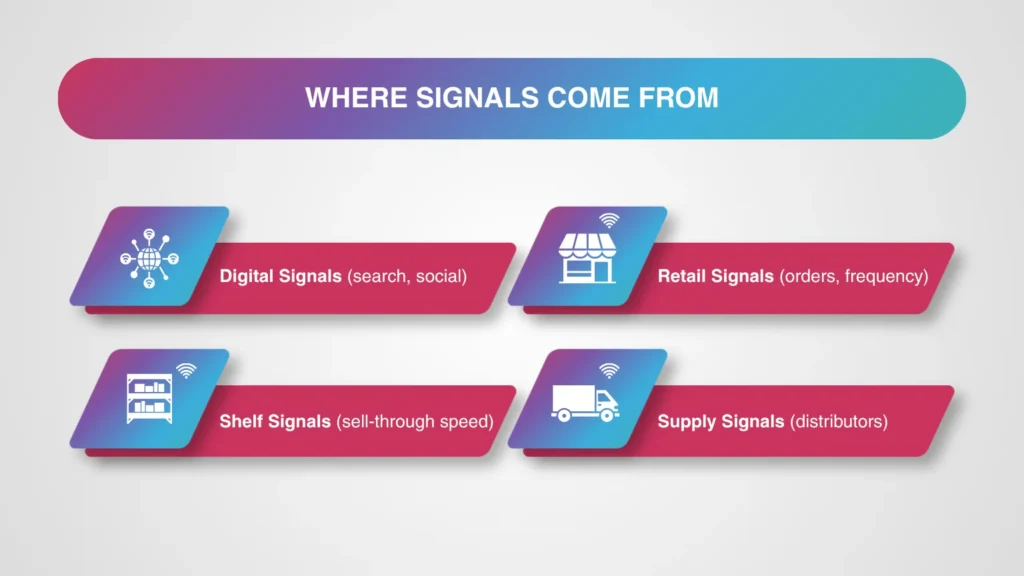
Sources of demand signals in FMCG

Even with access to large amounts of data, many FMCG teams remain reactive. Information is often spread across systems, reporting cycles are slow, and decision-making still leans heavily on historical trends.

Without strong supply chain visibility, it becomes difficult to connect these signals into a clear picture. This lack of visibility is a major reason why stockouts continue to happen, even in well-established organizations.

Moving from reactive to predictive
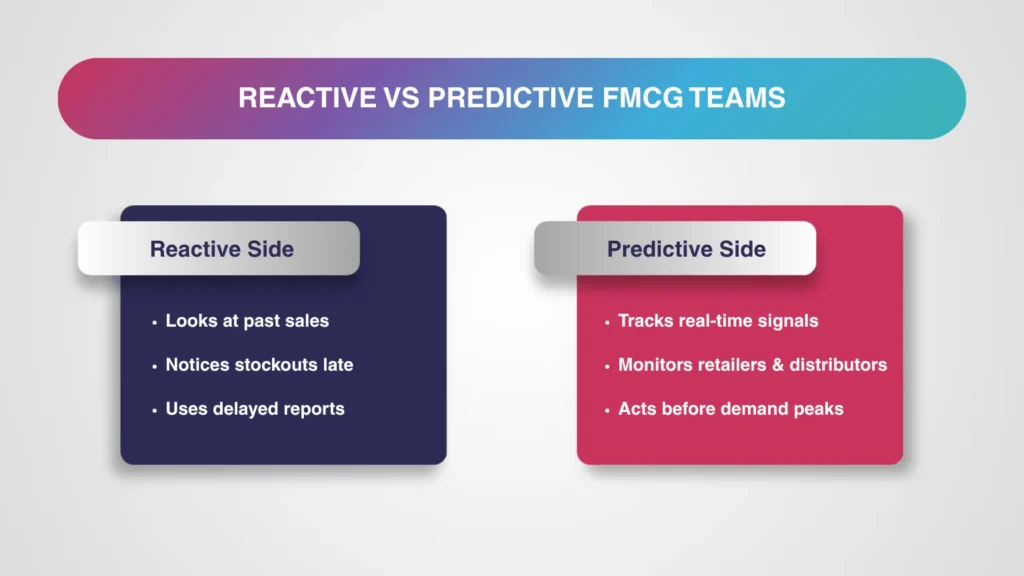
Reactive vs predictive FMCG planning

The shift toward better stockout prevention doesn’t require completely new data—it requires using existing data differently.

When teams improve supply chain visibility, strengthen demand planning, and align their inventory management with real-time signals, they start to anticipate demand rather than chase it.

At the same time, integrating smarter FMCG demand forecasting models allows businesses to respond faster to changes that would have previously gone unnoticed.

Turning Demand Signals into Action with SpectraOne

Recognizing early demand signals is only part of the equation. The real challenge is connecting these signals across systems and acting on them quickly enough to prevent stockouts.

This is where platforms like SpectraOne come into play.

Instead of relying on disconnected reports, it brings together data from distributors, retailers, and digital channels into a single view. This allows FMCG teams to detect shifts in demand as they happen, rather than weeks later.

For example, if a regional spike in sales begins to emerge, the system can flag it early—helping teams adjust supply before shelves start going empty. Similarly, changes in retailer ordering patterns or faster inventory movement can be tracked in real time, making stockout prevention more proactive than reactive.

By strengthening supply chain visibility and improving demand planning, tools like SpectraOne help teams move from simply tracking performance to actually predicting it.

Final thought

Stockouts are rarely unpredictable. They are often the result of signals that were present but overlooked.

The brands that consistently stay ahead are the ones that recognize these patterns early and act before the problem becomes visible to everyone else.
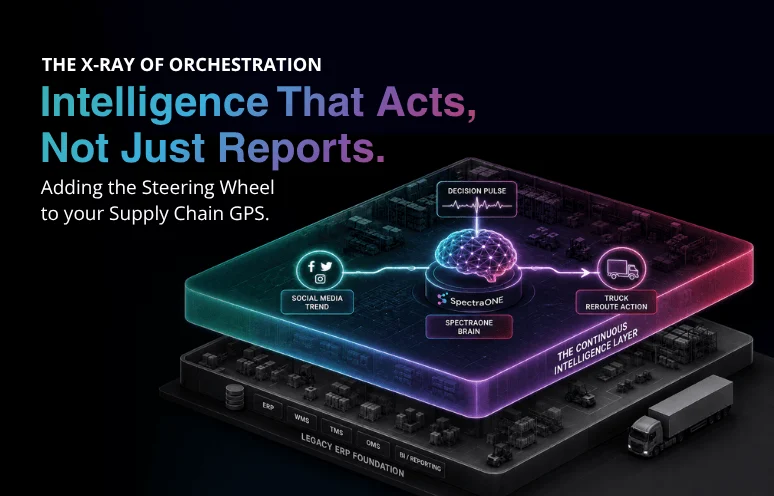
Supply Chain Orchestration is the Key to Autonomous Logistics

If you’ve spent your career in operations, you’ve likely spent most of your time “reacting.” For decades, the goal was to get better data, which we called Visibility. We wanted to see every shipment on a map.

Think about this, if your GPS tells you there is a traffic jam 5 miles ahead, but your car can’t suggest a new route or steer itself, has that information actually made you move faster? Probably not. You’re still stuck in the car, manually figuring out the next move.

This is the difference between traditional tracking and Supply Chain Orchestration. While visibility shows you the problem, orchestration is the hand that actually turns the steering wheel.

Supply Chain Orchestration

In the simplest terms, Supply Chain Orchestration is the automated coordination of different business systems to execute an action. It is the “brain” that connects your sales data, warehouse inventory, and shipping carriers so they work as a single, synchronized unit. 

Instead of humans moving data from one system to another, the orchestration layer handles the hand-offs automatically to ensure the right product reaches the right place at the right time.

The Evolution from Visibility Tools to Agentic AI Systems

To understand where the industry is going in 2026, we have to look at how decisions are made. Most companies today use Predictive AI. It looks at historical data and says, “You will likely need 500 units next Tuesday.” That’s a prediction, but it isn’t an action.

The next step, and what is currently ranking as the most important shift in logistics, is Agentic AI.

Visibility Tools to Agentic AI Systems

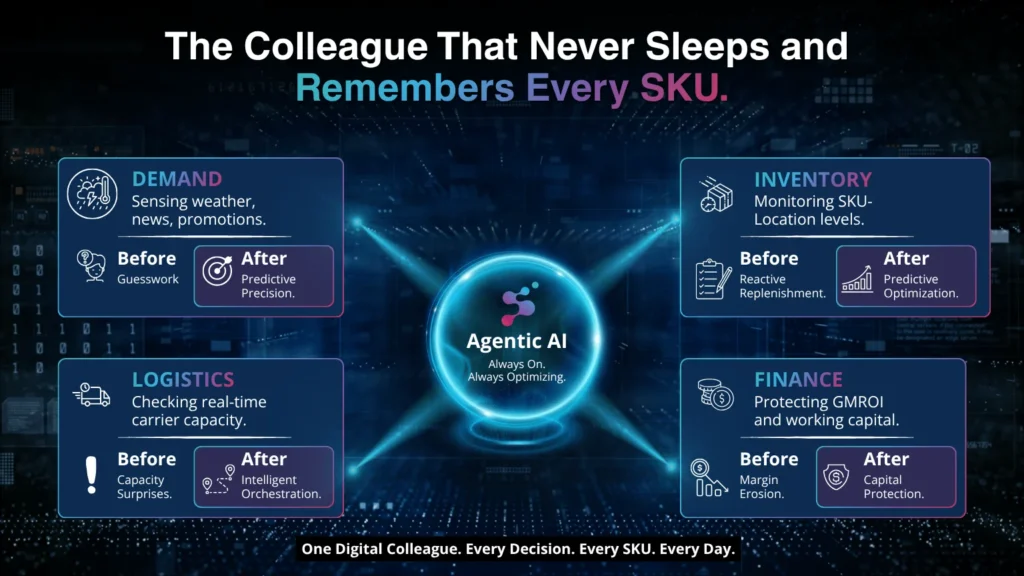
Think of an “Agent” as a Digital Colleague who has been given a specific mission. Unlike a standard software tool that waits for you to click a button, an Agentic system is authorized to find the solution within your rules. It doesn’t just tell you that stock is low; it also considers your warehouse levels, checks carrier availability, and prepares the transfer order for your approval.

How Orchestration Closes the Action Gap in Modern Manufacturing

The highest cost in your business isn’t the price of fuel; it’s the Action Gap. This is the dead time between sensing a change in the market and executing a physical response. Let’s take an example, a sudden surge in demand for a specific product in a northern region due to an unpredicted weather shift.

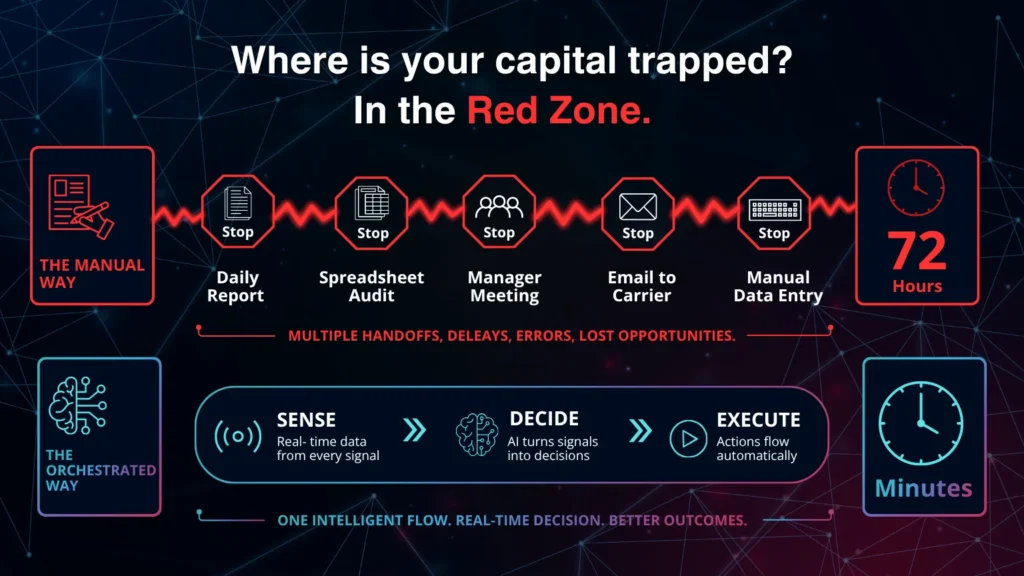
The Manual Way: A planner sees the sales spike on Wednesday. They check inventory in other regions on Thursday. They call a carrier on Friday. The stock arrives next Tuesday. You’ve lost 6 days of sales.

The Orchestrated Way: An Agentic AI layer senses the surge in real-time. It immediately identifies a surplus of that same item in a southern warehouse where demand is cooling. It calculates the shipping cost and automatically queues the shipment.

Action Gap shrinks from days to minutes

The “Action Gap” shrinks from days to minutes. By using Demand Forecasting that actually connects to execution, you ensure that capital is never sitting still when it could be moving toward a customer.

Building a Continuous Intelligence Layer without Replacing Your ERP

One of the reasons experts often ignore new software is the fear of a “Rip and Replace” implementation. You’ve spent years getting your ERP (Enterprise Resource Planning) system to work; you don’t want to start over.

The good news is that orchestration doesn’t require a new foundation. It acts as a Continuous Intelligence Layer that sits on top of your existing tools.

At SpectraONE, we call this the Digital Handshake. The software “listens” to your current data streams to find where your inventory is stagnating or where your shipments are consistently late. It doesn’t replace your planners; it empowers them. It handles the high-volume, repetitive math so your team can focus on high-level strategy and building better supplier relationships.

Why Decision Velocity is the New Competitive Advantage

In 2026, the companies that win are not the ones with the most data, but the ones with the highest Decision Velocity.

If your team is still spending 80% of their day in spreadsheets, you aren’t orchestrating; you’re just documenting history. By adopting Autonomous Logistics tools, you move the work from “data entry” to “data architecture.”

A question for your leadership team: Are we still hiring people to watch a screen and wait for problems, or are we ready to give them an engine that helps them drive the business forward?

If you’re curious about where your own “Action Gaps” are hiding, the first step isn’t a new system; it’s an audit of your Actual Demand Elasticity. Once you see where the math is breaking down, the path to orchestration becomes clear.

Request to connect

Scaling to 10-Minute Delivery: How to Maintain Elite SLAs Without Drowning in Dead Inventory

This narrative is for you if you are planning or currently expanding into Quick Commerce (Q-commerce) or if you are struggling to maintain Same-Day/10-Minute delivery promises.

This is a deep dive into why traditional safety stock models fail in high-velocity environments and a step-by-step breakdown of how a “Continuous Intelligence Layer” transforms stagnant inventory into capital velocity without requiring an expensive ERP overhaul.

A 5:30 PM Logistics Meltdown

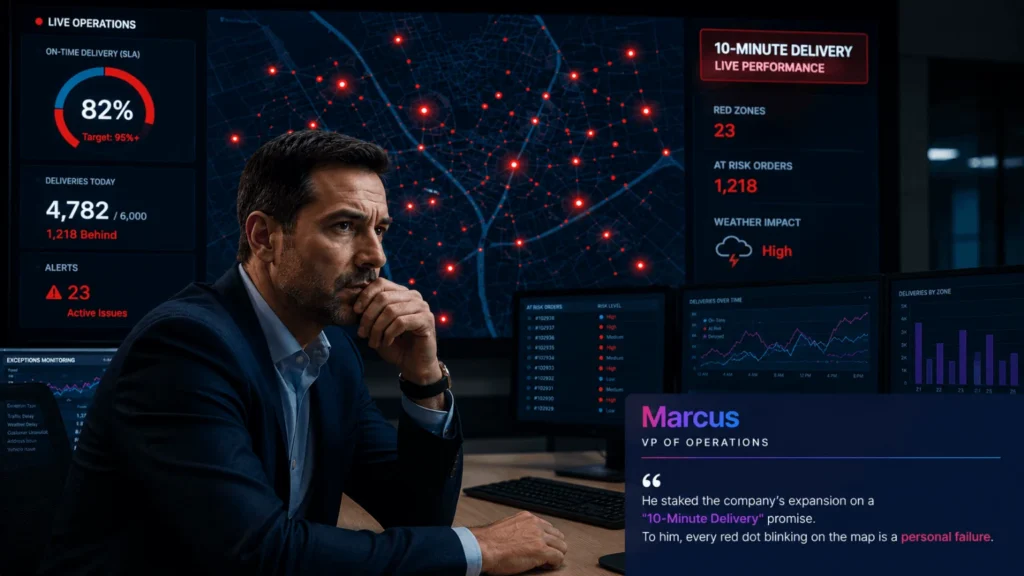
The air in the “Command Center” was thick with the silent vibration of server fans and the bitter smell of over-extracted espresso. Outside, a flash thunderstorm had just turned the city streets into a gridlocked nightmare. 

In 2026, a storm isn’t just weather; it’s a high-stakes logistics catastrophe for any brand promising speed.

Let’s get real about who’s on the front lines, no more hiding behind job titles.

VP of Operation
Senior Demand Planer

The tension peaked as the monitors began to pulse red. “Linda, report,” Marcus barked.

“Demand for waterproof gear just spiked 500% downtown,” Linda replied, her voice tight. “But the system is showing ‘Zero’ on-hand at Leo’s store. We have the stock, it’s just stuck in the suburbs where it’s not even raining yet.”

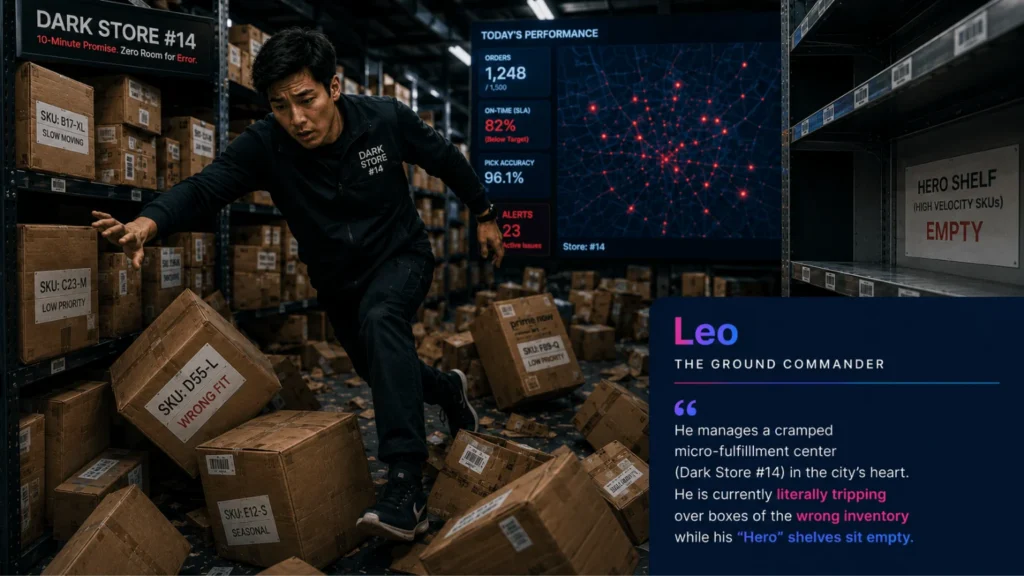
Managing a Store

Leo appeared on the video link, frazzled. “Marcus, I’ve got enough laundry detergent here to wash the whole city, but I haven’t seen an umbrella in days. I’m out of shelf space, and my riders are sitting idle because I have nothing for them to deliver.”

Why “Buffer Stock” is a 2015 Solution for a 2026 Problem

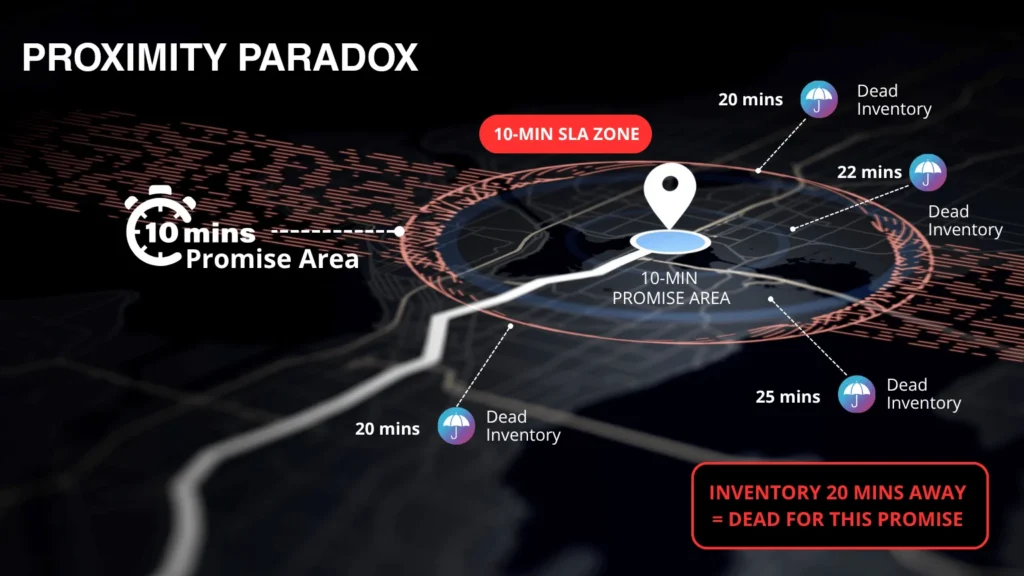
Proximity-Paradox

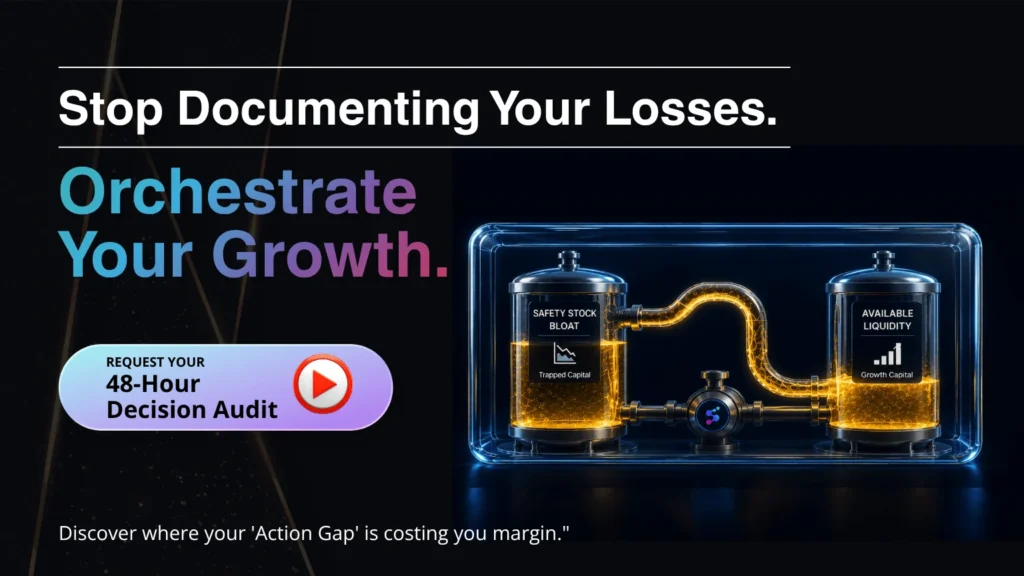
In this scenario, the brand is suffering from the Proximity Paradox. They have plenty of inventory, but it is “dead” because it is 20 minutes away from a 10-minute promise. Most brands try to solve this by increasing “Safety Stock”, stuffing every local hub to the gills just to survive the next hour.

But what if, instead of adding more “weight” to the shelves, they added a layer of intelligence?

It’s Not Magic, It’s Math: The SKU-Location Pulse

If an intelligence layer like SpectraONE were introduced into this “War Room,” the first change wouldn’t be a new warehouse; it would be a shift in the mathematics of replenishment. Traditional tools use “Averages” to calculate what a region needs over a month. But 10-minute delivery requires SKU-Location Demand Elasticity. This is the math of understanding how demand “bends” based on hyper-local signals. 

The engine doesn’t ask, “How much do we need in the city?” 

SpectraONE asks, What is the probability of a sale at Node #14 specifically between 5:00 PM and 7:00 PM on a rainy Tuesday?

Turning “Signals” into Flow

By ingesting Multi-Source Transactional Signals, real-time weather fronts, local traffic patterns, and even social sentiment, the engine identifies “Trapped Capital.” It would see the umbrellas in the suburbs and the laundry detergent downtown as “misallocated assets.” It doesn’t wait for a human to notice; it calculates the “Pulse” and triggers a Pre-emptive Rebalance hours before the storm hits.

Improving Workflow Without Disturbance

Improving Workflow Without Disturbance

The biggest fear in the supply chain is the “Total System Transplant.” Leaders stay away from AI because they assume it will break their daily operations. 

However, a true intelligence layer like SpectraONE works through a “Digital Handshake.” It doesn’t replace the existing ERP; it plugs into the data streams (POS, WMS, ERP) via API.

How it changes the daily routine:

  • No Manual Entry, the engine learns quietly in the background.
  • Recommendation vs. Reaction, instead of Linda spending six hours in Excel trying to find out where the stock is, she arrives at her desk to find three “Recommended Actions.” She clicks “Approve,” and the mid-mile transfers are triggered automatically.
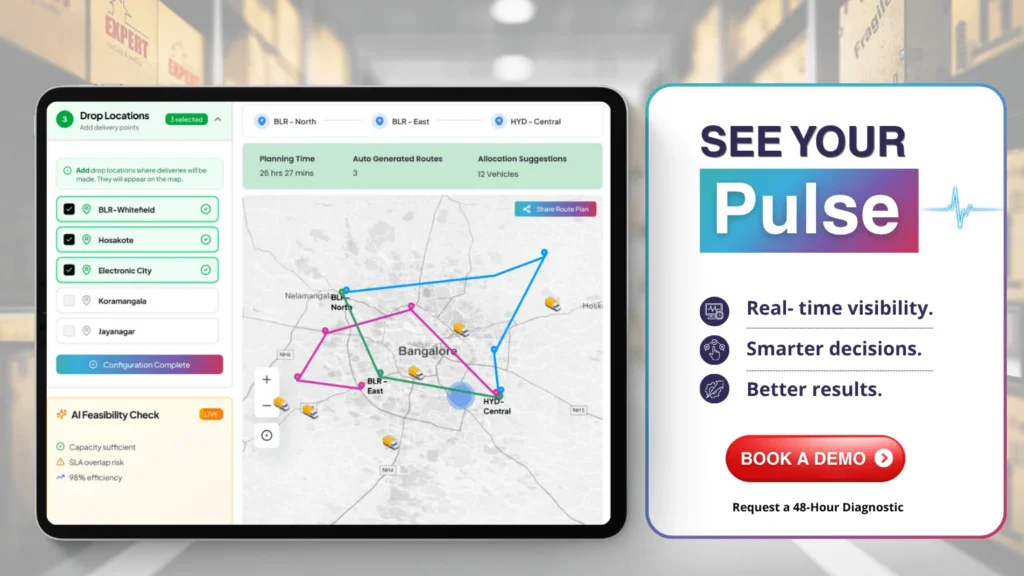
  • The 48-Hour Diagnostic means onboarding doesn’t take months. Within two days, the engine can map every “Invisible Leak” in the current network, showing the team exactly where their cash is stuck.

The Long-Term AI Benefit

Why is this needed now? Because in 2026, the “Bullwhip Effect” (where small changes in demand cause massive inventory swings) is moving faster than human spreadsheets can follow. AI doesn’t replace the team; it promotes them.

  1. Reclaiming Time

When the engine handles 80% of routine replenishment, Linda and Marcus stop being “firefighters.” They finally have time to focus on vendor negotiations, new product launches, and strategic expansion.

  1. Long-Term Predictability

Over time, the AI learns the “DNA” of the brand’s demand. It predicts seasonal shifts months ahead, so capital is never “frozen” in safety stock that won’t move.

Why Brands Wait (and Why They Shouldn’t)

Many companies stay away from these shifts because they are waiting for a “Magic Update” from their legacy systems. They believe that their 2015-era ERP or other tools will eventually “add AI” that fixes everything. You have to accept:

Legacy systems are built for “Recording,” not “Deciding.” Adding AI to an old ERP is like putting a jet engine on a horse-drawn carriage. It wasn’t built for the “Continuous Intelligence” required for 10-minute SLAs.

“Perfect Data” is a myth. Brands wait to “clean their data” before trying AI. But advanced engines like SpectraONE are designed to find patterns within the mess. They are the filter that cleans the data.

A few Truths for the Decisive Leader

  • Your safety stock is not a “Security Blanket”; it is a graveyard for your cash flow.
  • A 99% fulfillment rate is a failure if it requires 20% excess inventory to achieve it.
  • Visibility is just “looking at the fire.” Decision Intelligence is “preventing the spark.”

The “Ghost” in the dark store, that dead inventory that kills your GMROI, isn’t a mystery; It’s just bad math. The question is no longer whether the technology exists to fix it; the question is how much longer you can afford to pay the “Invisible Tax” of staying static.

book-a-demo