AI Signal
Risk identified early

Detect Supplier Risks Before They Disrupt Operations
Supplier networks are becoming increasingly complex. Global sourcing, multi-tier supplier dependencies, and changing demand patterns mean even a small issue with one supplier can impact production, inventory, and customer commitments.
Most organizations manage supplier risk using spreadsheets, scorecards, and occasional performance reviews. While these tools track past performance, they provide limited visibility into emerging risks.
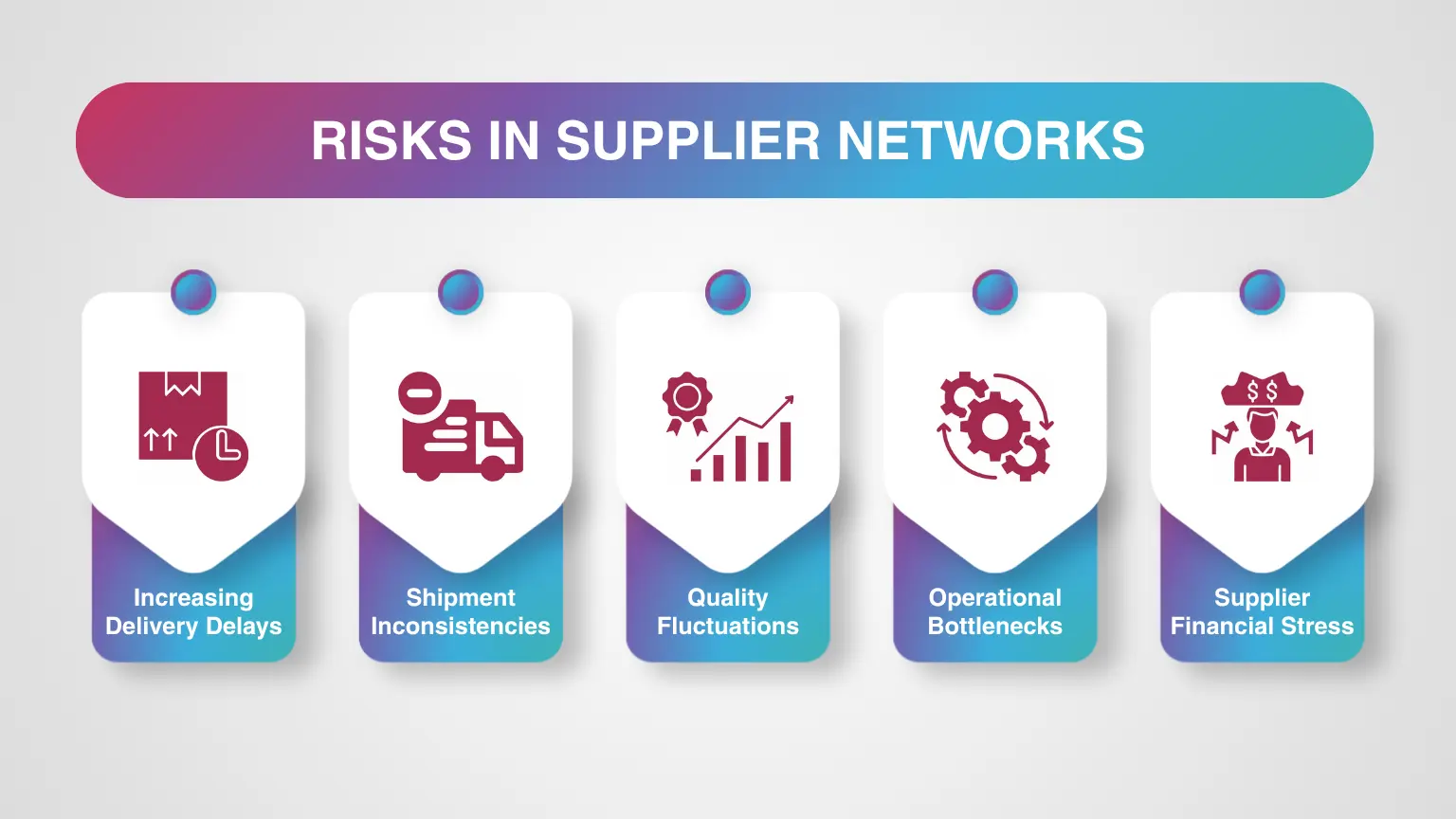
Supplier disruptions rarely occur suddenly. They typically begin with early warning signals such as:
When these signals go unnoticed, they can lead to production delays, inventory shortages, and costly recovery measures.
Traditional supplier risk management tools struggle to keep pace with modern supply chain complexity.
Data is often fragmented across systems: procurement platforms track purchase orders, logistics tools monitor shipments, and ERP systems manage inventory. This lack of integration makes it difficult to detect early warning signals.
Manual monitoring also introduces delays, with teams relying on periodic reviews. By the time risks are identified, operational impact has often already occurred.
Supplier risk management is becoming more complex across industries such as manufacturing, automotive, retail, pharmaceuticals, and consumer goods.
Managing supplier risk is increasingly difficult due to expanding global sourcing, fluctuating demand patterns, and frequent disruptions from external events like geopolitics, weather, and logistics delays.
AI transforms supplier risk monitoring from a reactive process into a proactive capability.
Instead of periodic reviews, AI continuously analyzes operational signals across procurement systems, logistics networks, inventory data, and supplier performance metrics.
By identifying anomalies and emerging patterns, AI highlights potential risks before they escalate into disruptions.
An AI-driven supplier monitoring platform acts as an intelligence layer across existing enterprise systems.
It continuously analyzes data from procurement platforms, logistics systems, supplier scorecards, and planning tools to detect emerging risks.
When anomalies are detected, the system generates real-time alerts with actionable insights. Teams can quickly assess the impact and take corrective actions such as switching suppliers, adjusting inventory, or modifying production plans.
Real-time supplier monitoring, predictive risk detection, instant disruption alerts, and end-to-end visibility help organizations respond faster and make informed decisions.
Supplier disruptions can lead to significant financial losses, including expedited shipping costs, emergency sourcing, production downtime, and lost revenue.
AI-driven supplier monitoring enables early intervention and risk mitigation.
Manufacturers prevent production delays through early risk signals, retailers balance inventory using shipment insights, and pharmaceutical companies ensure continuity by tracking supplier reliability across regions.
Supplier ecosystems will continue to grow in complexity. Organizations that rely on historical reporting alone will struggle to manage emerging risks.
AI for supplier risk monitoring enables enterprises to detect disruptions early, respond faster, and maintain stable operations across global supply networks.
With advanced AI capabilities, SpectraOne supports organizations in strengthening supplier risk managem ent, preventing supply chain disruptions, and building more resilient and responsive supply networks.
SpectraOne is an AI-powered procurement intelligence platform that helps organizations gain real-time visibility into supplier performance, risks, and opportunities across their supply chain. By unifying data from procurement, logistics, and operational systems, SpectraOne enables predictive supplier risk analysis, continuous monitoring, and faster decision-making.