Supply Chain Orchestration is the Key to Autonomous Logistics
If you’ve spent your career in operations, you’ve likely spent most of your time “reacting.” For decades, the goal was to get better data, which we called Visibility. We wanted to see every shipment on a map.
Think about this, if your GPS tells you there is a traffic jam 5 miles ahead, but your car can’t suggest a new route or steer itself, has that information actually made you move faster? Probably not. You’re still stuck in the car, manually figuring out the next move.
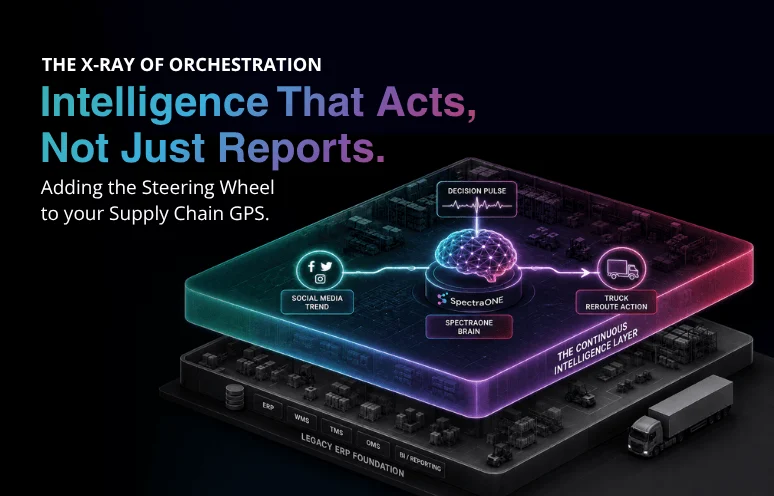
This is the difference between traditional tracking and Supply Chain Orchestration. While visibility shows you the problem, orchestration is the hand that actually turns the steering wheel.
Supply Chain Orchestration
In the simplest terms, Supply Chain Orchestration is the automated coordination of different business systems to execute an action. It is the “brain” that connects your sales data, warehouse inventory, and shipping carriers so they work as a single, synchronized unit.
Instead of humans moving data from one system to another, the orchestration layer handles the hand-offs automatically to ensure the right product reaches the right place at the right time.
The Evolution from Visibility Tools to Agentic AI Systems
To understand where the industry is going in 2026, we have to look at how decisions are made. Most companies today use Predictive AI. It looks at historical data and says, “You will likely need 500 units next Tuesday.” That’s a prediction, but it isn’t an action.
The next step, and what is currently ranking as the most important shift in logistics, is Agentic AI.
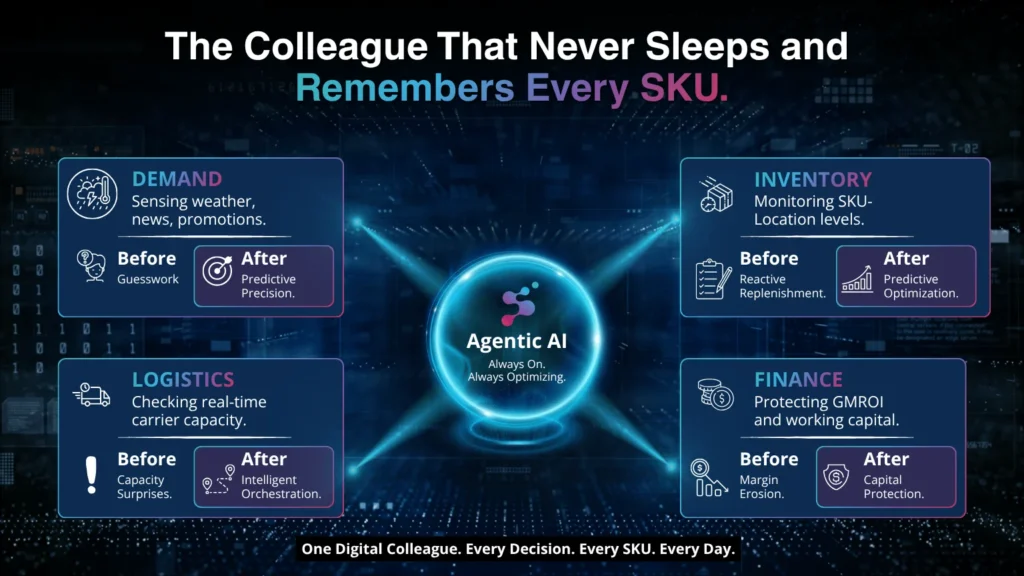
Think of an “Agent” as a Digital Colleague who has been given a specific mission. Unlike a standard software tool that waits for you to click a button, an Agentic system is authorized to find the solution within your rules. It doesn’t just tell you that stock is low; it also considers your warehouse levels, checks carrier availability, and prepares the transfer order for your approval.
How Orchestration Closes the Action Gap in Modern Manufacturing
The highest cost in your business isn’t the price of fuel; it’s the Action Gap. This is the dead time between sensing a change in the market and executing a physical response. Let’s take an example, a sudden surge in demand for a specific product in a northern region due to an unpredicted weather shift.
The Manual Way: A planner sees the sales spike on Wednesday. They check inventory in other regions on Thursday. They call a carrier on Friday. The stock arrives next Tuesday. You’ve lost 6 days of sales.
The Orchestrated Way: An Agentic AI layer senses the surge in real-time. It immediately identifies a surplus of that same item in a southern warehouse where demand is cooling. It calculates the shipping cost and automatically queues the shipment.
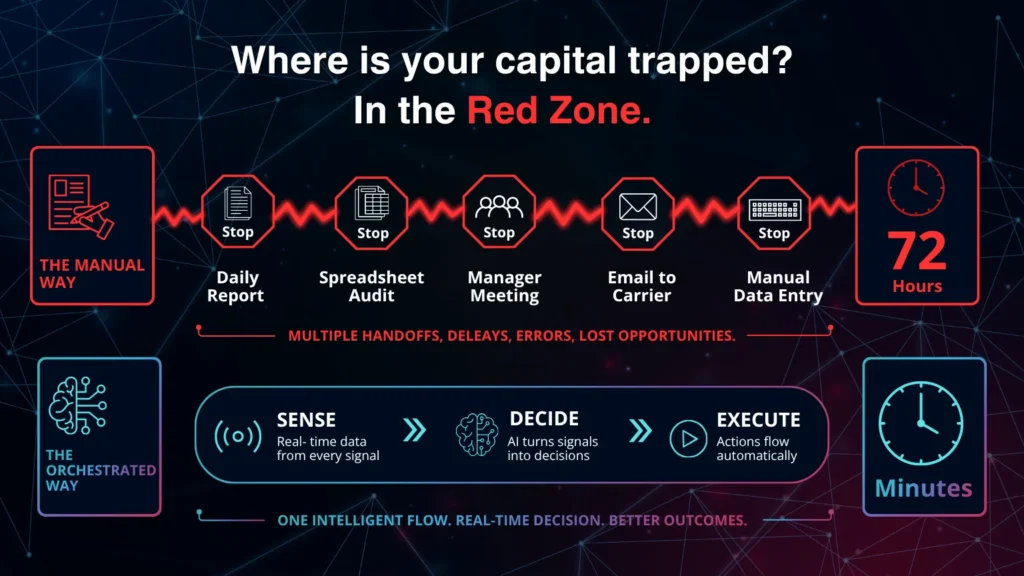
The “Action Gap” shrinks from days to minutes. By using Demand Forecasting that actually connects to execution, you ensure that capital is never sitting still when it could be moving toward a customer.
Building a Continuous Intelligence Layer without Replacing Your ERP
One of the reasons experts often ignore new software is the fear of a “Rip and Replace” implementation. You’ve spent years getting your ERP (Enterprise Resource Planning) system to work; you don’t want to start over.
The good news is that orchestration doesn’t require a new foundation. It acts as a Continuous Intelligence Layer that sits on top of your existing tools.
At SpectraONE, we call this the Digital Handshake. The software “listens” to your current data streams to find where your inventory is stagnating or where your shipments are consistently late. It doesn’t replace your planners; it empowers them. It handles the high-volume, repetitive math so your team can focus on high-level strategy and building better supplier relationships.
Why Decision Velocity is the New Competitive Advantage
In 2026, the companies that win are not the ones with the most data, but the ones with the highest Decision Velocity.
If your team is still spending 80% of their day in spreadsheets, you aren’t orchestrating; you’re just documenting history. By adopting Autonomous Logistics tools, you move the work from “data entry” to “data architecture.”
A question for your leadership team: Are we still hiring people to watch a screen and wait for problems, or are we ready to give them an engine that helps them drive the business forward?
If you’re curious about where your own “Action Gaps” are hiding, the first step isn’t a new system; it’s an audit of your Actual Demand Elasticity. Once you see where the math is breaking down, the path to orchestration becomes clear.