Demand Planning for Mid-Market Pharma Manufacturers

Demand planning has become one of the most important capabilities for pharmaceutical manufacturers. A delayed batch or stock shortage isn’t just an operational issue- it can affect pharmacies, healthcare providers, and patients waiting for critical medicines.  At the same time, manufacturers have to deal with strict regulations, changing demand, expiry dates, production constraints, and rising cost pressures. For mid-market pharma manufacturers, these challenges can feel even bigger because teams are often working with limited planning resources and disconnected systems.

This is where demand planning plays an important role. It helps manufacturers look beyond past sales, understand what demand may look like in the coming weeks or months, and make better decisions around production, purchasing, and inventory.

Why Demand Planning Is Important in Pharma
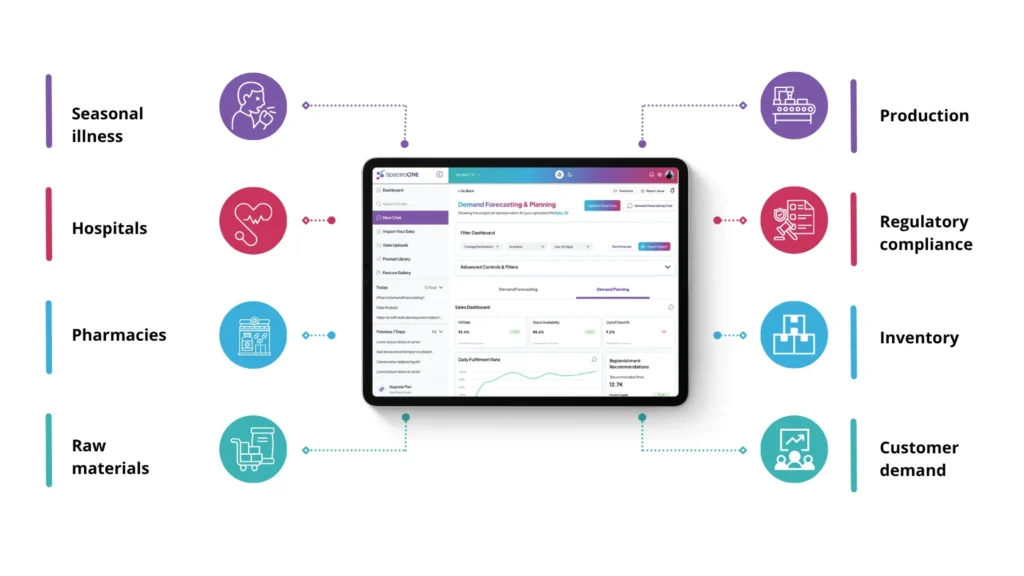
Multiple demand drivers affecting planning

Demand planning in pharma is not as simple as checking last year’s sales and increasing the number slightly. Demand can change for many reasons. Seasonal illnesses can increase the need for certain medicines. A distributor may place a larger-than-usual order. A hospital group may change its buying cycle. A new regulation or market change may also affect how much product is needed and when.

At the same time, pharma manufacturers need to manage product shelf life, batch production, raw material availability, and compliance requirements. If planning is not accurate or connected across the business, problems can build up quickly. For example, a company may have strong demand for a product but not enough raw material to produce it on time, or it may produce more than the market needs and end up with inventory that gets close to expiry.

Good demand planning helps teams avoid these situations by giving them a clearer view of what is coming and what actions they need to take.

The Real Cost of Poor Planning
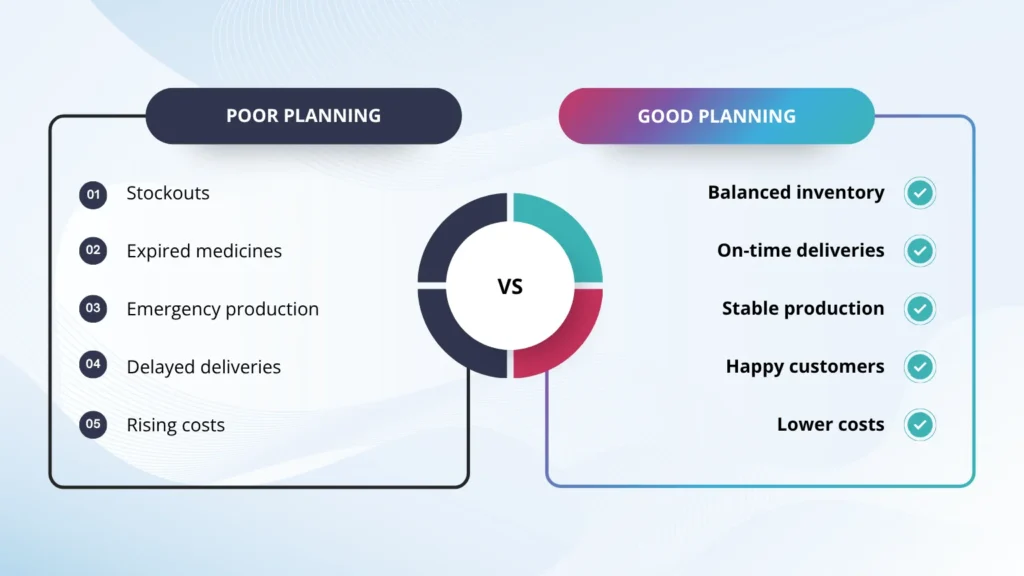
Poor Planning vs Effective Planning

Poor planning often shows up in ways that are easy to miss at first.

A production team may have to run urgent batches. Procurement may need to pay more for last-minute raw materials. Warehouse teams may struggle with excess stock. Sales teams may have to explain delays to customers.

Over time, these issues become expensive. For example, if a manufacturer produces too much of a slow-moving medicine, that stock may sit in the warehouse for months. Because pharma products have expiry dates, the company may eventually need to discount, destroy, or write off that inventory.

On the other hand, if the company underestimates demand, it may run out of stock. This can lead to missed sales, unhappy customers, and pressure on production teams to react quickly.A better demand planning process helps reduce these risks. It allows manufacturers to spot changes earlier, adjust plans faster, and make decisions based on current data instead of guesswork.

Why Forecast Accuracy Alone Isn’t Enough 

Many companies focus heavily on forecast accuracy. That makes sense, but it is only one part of the planning process. A forecast can be accurate on paper and still fail in practice.

For example, the forecast may show the right total demand for the month, but inventory may not be available in the right region. Or the forecast may be correct, but production may be delayed because a key raw material has not arrived.

This is why demand planning needs to be connected with the rest of the supply chain.

It should help answer practical questions such as:

  • Do we have enough raw materials?
  • Can production meet the expected demand?
  • Is the inventory in the right location?
  • Are there any products at risk of expiry?
  • Are customer orders changing faster than expected?

When demand planning is connected to procurement, production, inventory, and sales, teams can make better decisions and respond more quickly.

Creating a More Connected Planning Process

One of the biggest challenges for mid-market pharma manufacturers is that planning information is often spread across different teams and systems.

Sales may have one view of demand. Production may have another. Procurement may be working from a separate file. Warehouse teams may have their own inventory reports.

When this happens, it becomes difficult to create one clear plan.

A connected planning process brings important information together, including:

  • Historical sales
  • Current customer orders
  • Distributor demand
  • Inventory levels
  • Production capacity
  • Raw material availability
  • Supplier lead times
  • Expiry dates
  • Seasonal trends

With this information in one place, teams can make decisions faster. They can see where demand is changing, where supply may be limited, and where inventory needs attention.

This also improves teamwork. Instead of debating whose spreadsheet is correct, teams can focus on solving the actual problem.

Using Data to Plan Better

Modern demand planning gives pharma manufacturers a better way to use the data they already have.

Rather than waiting until the end of the month to review performance, teams can monitor demand and supply changes more regularly. This helps them react before problems become serious.

For example, if distributor orders start rising earlier than expected, planners can review available inventory and production capacity. If a raw material shipment is delayed, they can check which products may be affected and adjust the plan.

Data also helps manufacturers compare different options. A planning team can look at what might happen if demand increases, a supplier is late, or production capacity is limited.

This kind of scenario planning is useful because it helps teams prepare instead of simply reacting.

How SpectraONE Helps

Many mid-market pharma manufacturers still rely on disconnected spreadsheets and ERP reports for planning. SpectraONE brings demand, inventory, and production data into one connected platform, helping planners make faster and more confident decisions. 

With AI-powered forecasting, real-time visibility, and scenario planning, SpectraONE helps teams make faster and more confident decisions. It also integrates with existing ERP systems, so manufacturers can improve planning without replacing the tools they already use.

By using SpectraONE, pharma manufacturers can reduce stockouts, avoid excess inventory, improve forecast accuracy, and respond more quickly when market demand changes.

Planning for Growth

As pharma manufacturers grow, planning naturally becomes harder.

More products, more customers, more suppliers, and more markets all add complexity. A spreadsheet-based process that worked in the past may no longer be enough.

At some point, the business needs a more structured approach to demand planning.

This does not only mean better software. It also means better processes, clearer ownership, and stronger collaboration between teams.

With the right planning process in place, manufacturers can:

  • Reduce stockouts
  • Avoid excess inventory
  • Improve production planning
  • Manage expiry risk
  • Make better purchasing decisions
  • Improve customer service
  • Support business growth

For mid-market manufacturers, this can make a real difference. It helps the business grow without creating unnecessary pressure on planning teams.

Wrapping Up
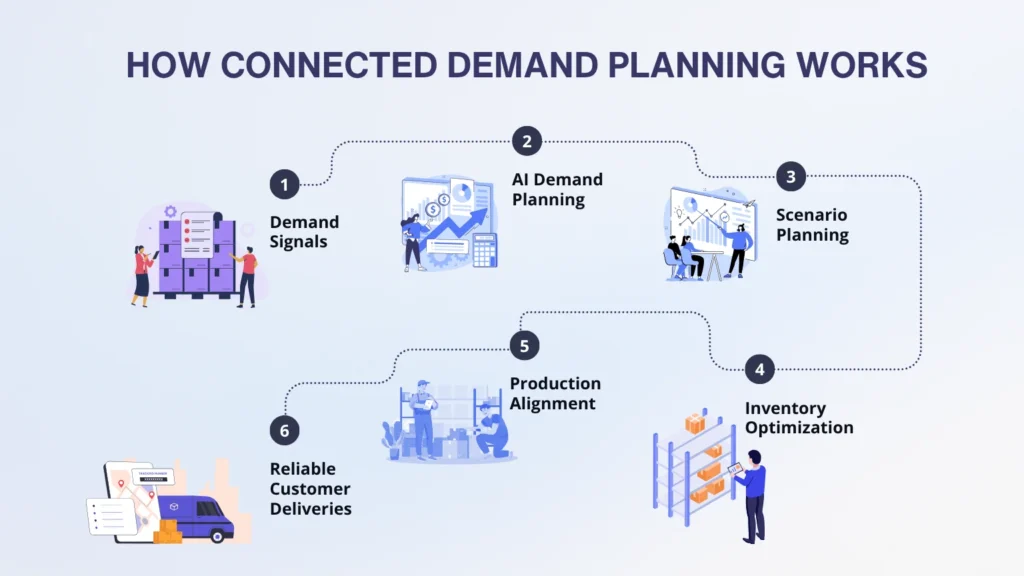
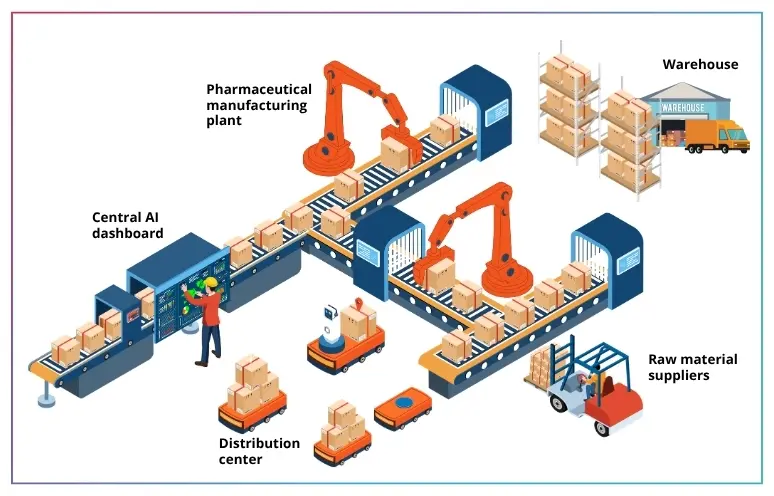
How demand Planning works

For pharma manufacturers, demand planning is much more than a forecast. It is a way to connect sales, production, procurement, and inventory so the business can make better decisions.

When planning is disconnected, manufacturers face higher costs, more stock issues, and slower responses to market changes. When planning is connected, teams can see problems earlier and act with more confidence.

For mid-market pharma manufacturers, improving demand planning is one of the most practical ways to build a more reliable, efficient, and resilient supply chain.

Inventory Planning for Dairy Manufacturing: Solving Shelf Life Constraints

If you have been running a dairy plant or managing a dairy manufacturing supply chain for decades, you already know the daily pressure of balancing incoming milk solids. You live this life day in and day out. 

You are constantly trying to route raw milk to the cheese vats, the fluid lines, or the drying towers without overfilling your silos or trapping too much cash in finished stock. You do not need to know how milk spoils because you understand the chemistry and physical realities of the plant floor better than anyone else.

But let us be honest, the safety margins you used to rely on have completely vanished. According to recent McKinsey data from their annual dairy executive survey, nearly 57% of industry leaders say that protecting thin profit margins is their biggest daily battle. 

High shipping costs, labor shortages, and wild swings in raw material prices are squeezing profits from every angle. Because of these shifts, old-school ways of doing dairy inventory planning just cannot keep up.

What we cover in this article: 

  1. First, look closely at why the old rules of dairy inventory planning broke down.
  2. Next, identify how a targeted software layer can address your shelf life constraints.
  3. Then, make sure this software works with your existing systems instead of replacing them.
  4. Finally, ensure all of this happens without making your daily job more complicated.

Why Balancing Your Silos Used to Be Simple

Think back to how the supply chain operated a couple of decades ago. The entire business was much more localized. You bought raw milk from regional farms, processed it in a local balancing plant, and delivered it to nearby grocery stores.

That simple setup gave you a lot of operational breathing room for a few solid reasons:

  • Your product catalog was small and focused on standard fluid milk, butter, block cheese, and conventional milk powder. You did not have to schedule hundreds of different specialized drink formulas.
  • Grocery stores were highly flexible about expiration dates. They gladly accepted shipments even if the products had fewer days left on the shelf because local demand was so predictable.
  • Raw milk components stayed relatively uniform. If you had a sudden spike in milk deliveries, you could easily dump the extra fat and protein into the butter churn or the drying tower without overthinking the math.

The main goal back then was simply volume maximization. Because the distance from the farm to the store was so short, standard inventory tracking easily absorbed any minor mistakes.

The New Realities Crushing Your Freshness Windows

So what changed? Why has running a dairy manufacturing supply chain become so difficult over the last few years? It comes down to three massive pressures hitting your business at the exact same time.

  1. Consumer tastes have shifted heavily toward clean label and functional foods. Shoppers love high protein items and natural yogurts, but they absolutely reject artificial preservatives. Since you cannot use chemicals to extend freshness, your plant has to rely on advanced packaging and ultra high temperature processing. These natural products are highly perishable food inventory management assets, meaning their expiration clock starts ticking the very second they leave the filling machine.
  2. Grocery store chains now enforce strict zero tolerance rules for product age. Major supermarkets demand that your shipments have at least 80 percent of their original shelf life remaining the moment they arrive at their distribution centers. If a truck gets delayed by just 12 hours, the store will reject the whole load, hit you with a massive financial penalty, and look for another supplier.
  3. Milk production volatility is at an all time high. Between shifting environmental regulations and animal health uncertainties, the volume and component quality of the milk entering your receiving bays changes day by day.

Why Your Current ERP Fails the Math Test

When corporate leadership sees a spike in spoiled product or missed orders, they usually blame the logistics team or the warehouse crew. But as a supply chain professional, you know the real problem is sitting inside your enterprise resource planning database.

Traditional software treats shelf life constraints as fixed, static numbers inside a master file. For example, your current planning system probably assumes that every single batch of yogurt will stay fresh for exactly 45 days.

But in the physical reality of your plant, true shelf life changes every single day because of real world variables:

  • The actual fat and protein ratios in your raw milk fluctuate based on cow feed and local weather, changing the initial stability of the batch.
  • Clean in place cleaning cycles or sudden packaging line bottlenecks can cause milk to sit in holding tanks longer than planned, cutting its final shelf life short before it is even packaged.
  • Tiny temperature changes during shipping or warehouse storage can fast forward product degradation.

Because your current system cannot see these changes, its automated inventory calculations fail. The software keeps printing production schedules based on old historical averages. By the time your team notices that a batch is expiring too fast on the warehouse floor, that inventory has already turned into a massive loss.

How to Track Freshness in Real Time

How-to-Track Freshness-in-Real -Time

You do not need to replace your entire database platform or buy into an expensive, multiyear tech trap that makes your life harder. Industry leaders are highly cautious about generic software. As one North American dairy executive recently said, pilot programs for automated tools can be incredible, but teams are rightfully terrified of letting unproven software run loose on their plants. You cannot risk a software glitch causing a literal dump of raw milk.

In this condition, SpectraONE can help you. It acts like a practical, automated freshness orchestration assistant that works with your existing systems, not against them. It sits on top of your current software to bridge the gap between static numbers and the live conditions of your factory floor.

The platform protects your operations through three clear steps:

Live Expiry Calculations

SpectraONE continuously pulls data from your plant machinery, clean in place cleaning logs, and shipping sensors. Instead of guessing based on a calendar, it tracks exact remaining freshness based on real transport and processing conditions.

Smart Component Routing

When raw milk component levels change, the software instantly calculates the best way to balance those solids. If fluid demand drops, it helps you adjust the plant schedule in real time, directing extra fats and proteins into longer life items like aged cheeses or whey applications.

Proactive Order Rerouting

If a shipping delay or a hot warehouse compromises a product batch, SpectraONE alerts your planners immediately while the stock is still in your building. Your team can use first expiry first out logic to quickly reroute that batch to a nearby customer or a fast moving retail channel before it hits the store rejection limit.

The Financial Proof and Your Return on Investment

Adding an intelligent software layer is not a tech experiment. It delivers direct, measurable cash back to your bottom line. Let us look at a simple example for a mid-sized Indian dairy processing facility to see the exact math. 

Let us assume your plant processes a realistic mid-sized annual volume of raw milk equal to V = 7,30,00,000 liters (which equates to processing a steady 200,000 liters per day). 

The average wholesale revenue across your entire product portfolio (including liquid milk pouches, curd, paneer, and ghee) is P = ₹55 per liter. 

Your gross annual revenue R is calculated as follows:

V × P = R 

7,30,00,000 × ₹55 = ₹4,01,50,00,000 (₹401.5 Crore)

Every year, product spoilage, cold chain breaks, expired stock, and forced markdowns cost fresh food manufacturers about 2.0% of their total revenue. The annual cost of this lost freshness L.fresh​ is:

L.fresh ​= ₹401.5 Crore × 0.02 = ₹8,03,00,000 (₹8.03 Crore)

On top of that, modern retail chain fines, quick-commerce SLA breach penalties, and delivery returns cost another 0.5% of your revenue, which we will call  L.penalty​:

L.penalty​= ₹401.5 Crore × 0.005 = ₹2,00,75,000 (₹2.0075 Crore)

The total freshness waste liability under your old system is:

L.fresh ​+ L.penalty = ​ W.total​

₹8.03 Crore + ₹2.0075 Crore = ₹10,03,75,000 (₹10.0375 Crore)

When you add an AI platform like SpectraONE, your plant can easily cut this waste and penalty cost by a conservative estimate of 25% through real-time routing and component balancing. 

The saved money C.recovered​ that goes straight back to your operating profit as recovered cash is:

C.recovered​ = ₹10,03,75,000 × 0.25 = ₹2,50,93,750 (₹2.51 Crore)

This financial calculation highlights why optimizing your inventory methods is a highly practical business choice. By eliminating avoidable food waste and insulating your thin margins from supply disruptions, you can make your existing resources work much harder for your business.

Evaluating Your Path Forward Without the Tech Trap

SpectraONE is here to add clear, verified value to your business, not push a tool that does not fit your workflow. Explore the Interactive Demo 

A Zero-Pressure, Guided Run Through

If you prefer a direct conversation, booking a quick session is incredibly simple. 

Simple three-step process:

1. The Discovery Call: We schedule a brief call around your availability to learn about your specific plant bottlenecks.

2. Meet the Experts: We loop in our core product engineering team and internal supply chain experts to show you exactly how the software handles your unique workflows.

3. Assisted Trial: Run a fully supported trial program using your actual historical data trends.

Evaluate the automated logic on your own terms, and only move forward when you are completely satisfied with the results.

Prefer a quick callback instead? Click here to leave your contact details and an executive will reach out exactly at your convenience.

Demand Forecasting for Omnichannel Retail: Why One Model Doesn’t Work

Imagine a retailer forecasting demand for a bestselling sneaker. The forecast predicts sales of 20,000 units next month, and by the end of the month, that’s exactly how many pairs customers buy. On paper, the forecast is perfect. Yet the retailer still faces cancelled online orders, empty shelves in some stores, and excess inventory sitting in regional warehouses. How is that possible. The answer lies in one of the biggest misconceptions in omnichannel demand forecasting: assuming that one demand forecast can serve every sales channel equally.

Today’s customers don’t shop the way they did a decade ago. They browse products on social media, compare prices on marketplaces, check stock availability online, reserve products for in-store pickup, and switch between digital and physical channels throughout their buying journey. While customers experience retail as one connected journey, many businesses continue to plan inventory using a single consolidated forecast.

That approach is becoming increasingly difficult to sustain.

Modern retail isn’t struggling because organizations lack forecasting capabilities. The challenge is that omnichannel demand forecasting requires retailers to understand how demand behaves differently across every sales channel.

Why Omnichannel Demand Forecasting Is More Complex Than Ever

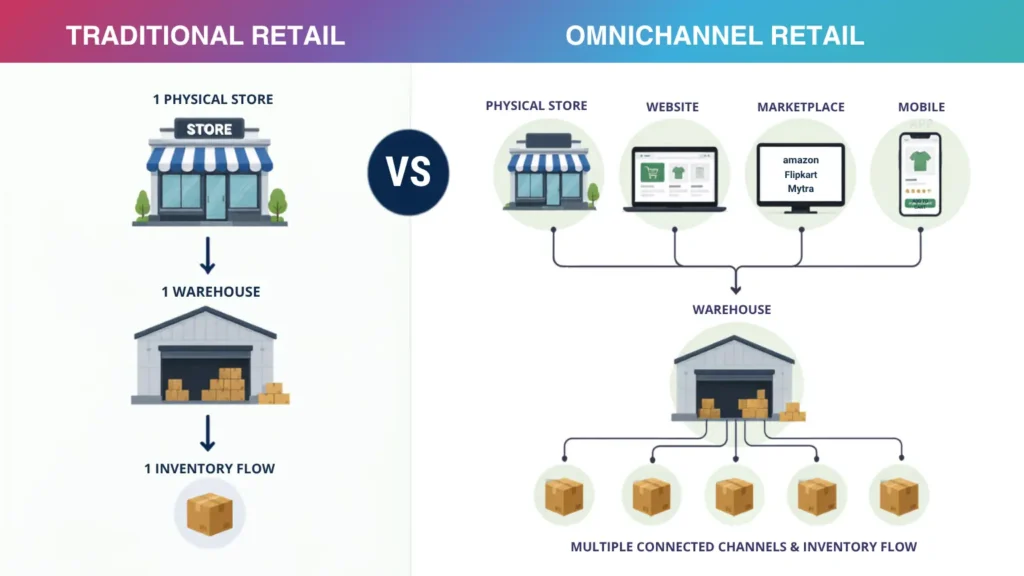
Traditional-Retail-vs-Omnichannel-Retail

Traditional retail forecasting was designed for a world where stores generated most sales and customer behavior followed relatively stable seasonal patterns.

Today, retailers operate across physical stores, brand websites, marketplaces, mobile apps, social commerce, and click-and-collect services. Each channel attracts different customers, responds to different marketing activities, and follows different purchasing patterns.

For example, an online promotion can generate thousands of orders within hours, while physical stores may experience a gradual increase in footfall over several days. A marketplace listing may suddenly gain visibility because of platform algorithms, whereas a nearby store sees increased demand because of a local event or weather conditions.

Although the product remains the same, the demand drivers are completely different.

This is why forecasting total demand alone is no longer enough. Retailers must understand where demand is likely to emerge, how quickly it may shift, and which channels require inventory first.

The Real Problem Isn’t Forecast Accuracy – It’s Demand Allocation

Forecast Accuracy Dashboard

One of the biggest misconceptions in retail planning is that improving forecast accuracy automatically improves inventory performance.

In reality, many inventory problems are allocation problems.

Imagine a retailer launching a new electronics accessory.

The overall monthly forecast is accurate, but an influencer review unexpectedly drives online demand far beyond expectations. Inventory, however, has already been distributed primarily to physical stores based on historical sales.

Within days, the e-commerce channel experiences stockouts, while stores continue holding inventory that customers aren’t purchasing. From a planning perspective, the business never ran out of stock. It simply had inventory in the wrong place.

This is becoming one of the defining challenges of omnichannel retail. Inventory exists across the network, but it isn’t positioned where customers are ready to buy.

Effective omnichannel demand forecasting goes beyond predicting total sales, it helps retailers position inventory where demand is most likely to occur.

Why Every Retail Channel Needs Its Own Demand Signals

Another reason omnichannel demand forecasting often fails is that each retail channel responds to unique demand signals.

Physical stores depend on location, local events, weather conditions, and foot traffic. E-commerce demand changes rapidly based on digital campaigns, search trends, and customer reviews. Marketplaces introduce another layer of complexity, where pricing, competitor activity, ratings, and platform algorithms significantly influence purchasing behaviour.

Click-and-collect adds yet another demand pattern, blending online convenience with local store fulfilment.

When retailers aggregate all these behaviours into one forecast, they risk overlooking the unique characteristics that drive demand in each channel.

This doesn’t mean every channel should operate independently. Instead, planners need forecasting approaches that recognise these differences while maintaining a unified view of inventory across the business.

Why Traditional Planning Metrics Are No Longer Enough

Forecast accuracy remains one of the most widely used performance indicators in retail planning.

While it remains important, it tells only part of the story. A forecast can achieve impressive accuracy and still fail operationally if it doesn’t support timely inventory allocation and replenishment decisions.

Today’s retail planners are increasingly expected to answer questions that extend beyond “How much will we sell?”

They must determine where inventory should be positioned, which channels should receive replenishment first, how promotions might influence individual sales channels, and how quickly inventory can be reallocated when customer demand changes.

Success is therefore measured not only by forecasting demand correctly but by responding to changing demand quickly and efficiently.

Moving Towards Channel-Aware Demand Planning

Leading retailers are shifting away from one-size-fits-all planning models and adopting omnichannel demand forecasting to better anticipate demand across stores, e-commerce, marketplaces, and fulfillment channels.

Instead of relying solely on enterprise-level forecasts, they combine overall demand forecasting with channel-specific insights, allowing them to identify where inventory should be positioned before demand materialises.

This approach enables retailers to anticipate changes in customer behaviour across channels while maintaining a connected view of inventory throughout the network.

Rather than asking, “How many units will we sell next month?” they begin asking more strategic questions:

  • Which channel is likely to experience the highest demand?
  • Can existing inventory support expected demand across every channel?
  • How will promotions influence customer purchasing behaviour?
  • What happens if customers switch channels during the buying journey?

These questions help transform forecasting into a broader planning capability that supports better operational decisions.

Conclusion

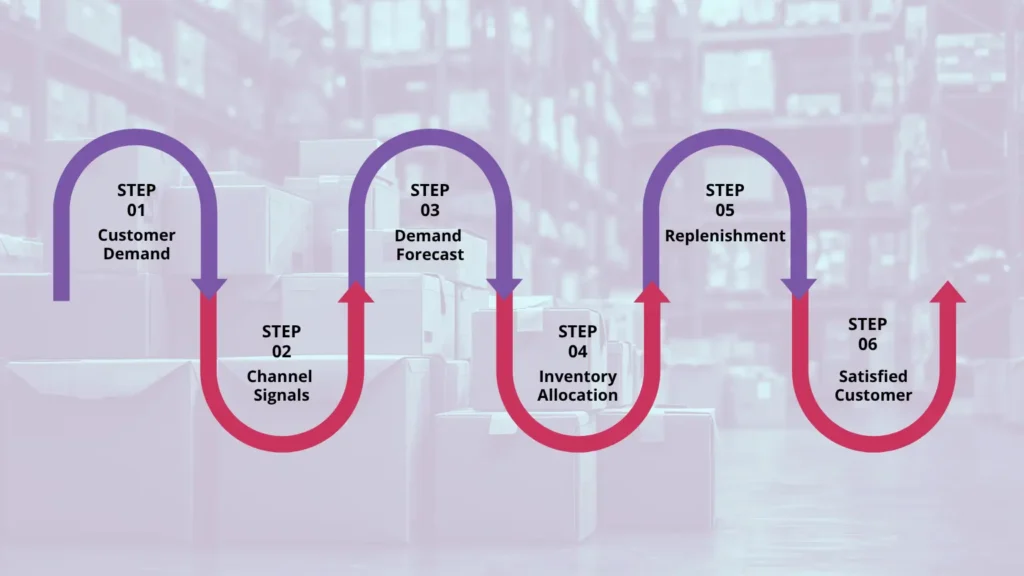
Demand Planning Flowchart

The evolution of omnichannel retail has fundamentally changed omnichannel demand forecasting and demand planning. A single forecast can no longer capture the complexity of customer behavior across physical stores, e-commerce platforms, marketplaces, and fulfilment models.

Retailers that continue treating demand as one aggregated number risk stockouts in high-demand channels, excess inventory in slower-moving locations, and rising operational costs. The retailers that succeed will be those that recognize an important shift in planning. The objective is no longer simply to predict how much customers will buy.

It is to understand where, when, and through which channel demand will emerge and ensure inventory is positioned to meet it.Because in today’s retail landscape, the most valuable forecast isn’t the one that’s closest to reality. It’s the one that helps businesses make the right inventory decisions before customers notice the difference.

ERP Lead Time Crises: How to Fix Electronics Supply Risk

Managing a modern electronics manufacturing supply chain involves a costly operational contradiction. Your enterprise likely invested heavily in an advanced ERP platform to optimize schedules. Yet, planners still manage critical parts of pipelines out of disconnected spreadsheets. Legacy databases regularly trigger severe MRP lead time failures because they rely on fixed, static data. This article explores how hidden component lead time volatility causes semiconductor component shortages and how to permanently correct your baseline ERP lead time errors. 

When electronic component delivery windows suddenly balloon from 12 weeks to 40 weeks, legacy inventory calculation models crash. That doesn’t mean your software is broken; its core database architecture was simply never designed to handle the external volatility inherent in modern global electronics logistics. To eliminate “lines-down” emergencies and reclaim your working capital, you need to understand exactly why your transactional software falls short and how to deploy a targeted intelligence layer to fix it.

Summary
Core transactional systems fail to predict component shortages because they are structurally built around static, internal parameters. For example:
• When global foundry allocations shift
• When tier-two raw material bottlenecks occur

In both cases, an ERP remains completely blind to the delay until a delivery is missed. 

True resilience requires augmenting your existing transactional database with real-time external risk-sensing software like SpectraONE to dynamically adjust planning inputs before supply shocks hit your production line.

Why Do Standard ERP Lead Time Calculations Fail?  

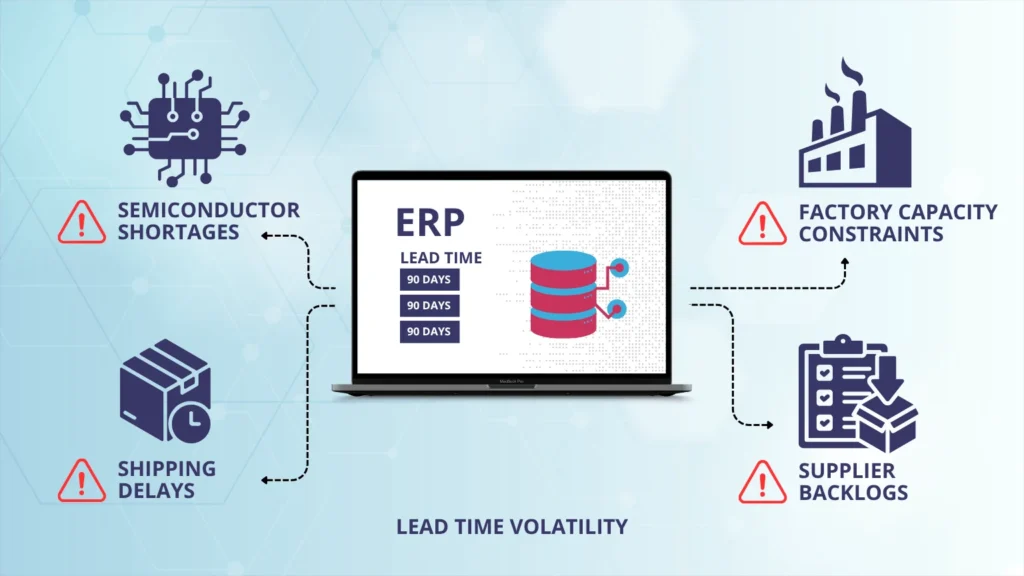
ERP-database

When a supply chain leader searches for a solution to inventory shortages, the root cause usually comes down to a fundamental software design flaw: ERPs operate inside a walled garden. Traditional Material Requirements Planning [MRP] engines trigger purchase orders using rigid mathematical formulas. First, the system checks internal historical sales trends. Next, it looks at current inventory records inside your warehouse management system [WMS]. Finally, it multiplies those numbers against the static value hardcoded into your material master files.

[Static Hardcoded Lead Time] x [Internal Historical Demand] = Flawed Purchase Order Timing

This logic works perfectly for stable, locally sourced commodities. However, it fails completely when applied to specialized electronics components like integrated circuits [ICs], custom microcontrollers, or multi-layered ceramic capacitors [MLCCs]. 

Here is why:

  • The Fallacy of the Fixed Field: An ERP treats lead time as a static parameter (e.g., 90 days). In reality, electronic component lead times are highly fluid, fluctuating daily based on global silicon wafer fabrication utilization, factory capacity allocations, and international shipping capacity.
  • The Backward-Looking Blind Spot: Your ERP’s data horizon is entirely internal and backward-looking. It knows when you placed past orders, but it has zero real-time visibility into the order backlogs of global semiconductor manufacturers or tier-two raw chemical suppliers.

Because your system cannot “sense” market signals outside its own database, it continues to execute purchase triggers based on outdated assumptions. By the time your system registers that a lead time has lengthened, the manufacturing gap has already closed, leaving your procurement team stranded in a multi-month vendor allocation backlog.

What happens to electronics manufacturing logistics when MRP lead times fail?

When material planners realize that the automated inventory schedules generated by their enterprise software are consistently inaccurate, it triggers an immediate psychological shift: system distrust. To protect the factory floor from running out of parts, planners take matters into their own hands, creating a cascade of hidden operational costs.

1. The Proliferation of Manual “Shadow IT”

To bypass inaccurate system dates, procurement teams export critical bills of materials into manual offline spreadsheets. This breaks your organization’s single source of truth. Suddenly, finance is forecasting cash flow based on ERP metrics, while procurement is purchasing materials based on unvalidated desktop calculations, leading to mass misalignment.

2. Artificial Safety Stock Inflation and Capital Lockup

To ease the constant anxiety of a “lines-down” emergency, planners begin manually padding their lead-time fields, adding arbitrary “buffer weeks” to every component order. This defensive ordering behavior creates an artificial bullwhip effect across your network. Your warehouse fills up with millions of dollars of raw material inventory you don’t immediately need, locking up vital working capital while you still run out of the one critical chip required to complete the build.

3. Severe SLA Erosion and Margin Penalties

In electronics assembly, a product cannot be shipped if it is missing a single surface-mount component. When a long lead-time part fails to arrive, partial assemblies pile up on the warehouse floor, work-in-progress [WIP] inventory spikes, and finished goods shipments stall. This directly damages your customer service level agreements [SLAs], forcing contract manufacturers to absorb expensive expedited shipping fees, client penalties, and lost future revenue.

MRP Failure ➔ System Distrust ➔ Spreadsheet Proliferation ➔ Inaccurate Buying ➔ Inflated Safety Stock & Lines Down

Combat Component Lead Time Volatility with Supply Chain Intelligence

real-time-supply chain-monitoring

Fixing this structural gap does not require you to undergo another multi-million-dollar, disruptive system migration. You do not need to replace your ERP; you simply need to change how it receives its operational parameters. Forward-thinking manufacturing organizations are solving this issue by deploying SpectraONE, an advanced supply chain intelligence overlay designed to bridge the gap between internal transactional execution and external market realities.

SpectraONE integrates directly on top of your existing IT infrastructure. By deploying real-time lead time risk sensing, our platform transforms your planning process from a reactive guessing game into an active, data-driven operation. This overlay provides targeted capabilities:

[SpectraONE Real-Time Lead-Time Risk Sensing] ➔ Updates Input Variables ➔ [Existing ERP/MRP Executes Correctly]

Proactive Lead-Time Risk Sensing

Instead of relying on the static historical averages saved inside your material master files, SpectraONE actively analyzes in real time:

• External supply signals

• Vendor capacity indices

• Macroeconomic logistics variables

The platform senses dynamic lead-time variances weeks before your standard scheduling engine is set to run. By flagging these adjustments early, SpectraONE gives your material planners the runway needed to:

• Adjust order parameters

• Advance purchase triggers

Before a global bottleneck chokes off your component supply.

Real-Time Alternate Sourcing Visibility

Sensing a future component shortage is only half the battle; procurement teams must also be empowered to act instantly. When SpectraONE detects an upcoming lead time blowout or vendor allocation risk, it automatically provides visibility into:

• Alternative supply networks

• Secondary distribution channels

This gives your sourcing specialists the real-time insights required to:

• Rapidly diversify their procurement strategies

• Secure secondary allocation pools

Maintain complete product continuity, entirely avoiding the manual search processes that slow down traditional operations.

By augmenting your foundational transactional database with SpectraONE‘s specialized risk-sensing and alternative sourcing intelligence, you can eliminate system distrust, protect thin manufacturing margins, and ensure your working capital is always optimized for maximum inventory turn.