
Why Better Forecasts Alone Won’t Fix FMCG Planning

For years, FMCG organizations have invested heavily in improving forecast accuracy. New forecasting models, more historical data, and increasingly sophisticated algorithms have all promised the same outcome: better demand predictions.

Yet many planning teams continue to struggle with stockouts, excess inventory, procurement delays, and constant firefighting.

Why?

Because the problem is often not the forecast itself. The problem is what happens after the forecast is generated.

The Hidden Gap in Demand Planning

Most demand planning processes are designed to answer a single question:

“What is likely to happen next?”

But planners are responsible for much more than predicting demand. They must also determine:

  • Whether current inventory can support future demand
  • Which suppliers can fulfill requirements
  • When replenishment should occur
  • How much to procure
  • What risks exist across the supply chain

Unfortunately, these decisions are often managed across disconnected systems and processes. Forecasting happens in one place, inventory planning in another, and procurement decisions are frequently driven by manual analysis.

As a result, planners spend significant time translating forecasts into actions instead of focusing on strategic decisions.

Why Historical Data Is No Longer Enough

Traditional forecasting models primarily rely on historical sales data. While historical trends remain important, they only tell part of the story.

A forecast generated without visibility into current inventory, orders already in progress, supplier performance, or existing purchase commitments creates blind spots that can impact planning outcomes.

Consider a scenario where demand is expected to increase next month. The forecast may correctly predict the increase, but planners still need to answer critical questions:

  • Do we have enough inventory?
  • Are suppliers capable of meeting demand?
  • Are there existing purchase orders already in motion?
  • When should replenishment begin?

Without these answers, even an accurate forecast can result in delayed decisions and operational risk.

This is where organizations are rethinking demand planning. Rather than relying solely on historical sales data, they are combining demand, inventory, supplier, and procurement signals to create a more complete picture of future demand.

At SpectraONE, this philosophy is central to our approach. By bringing together multiple operational data sources, planners gain visibility into demand within the context of inventory availability, supplier constraints, and procurement requirements.

The Shift from Forecasting to Decision Intelligence

forecasting-vs-decision-intelligence

Many organizations continue to measure planning success through forecast accuracy alone.

But a highly accurate forecast does not automatically lead to better business outcomes.

A forecast may be correct, yet stockouts can still occur if inventory is unavailable. Procurement delays can still happen if supplier constraints are not considered. Excess inventory can still accumulate if replenishment decisions are made too late.

This is why leading FMCG organizations are moving beyond forecasting and embracing decision intelligence.

Instead of asking:

“What is likely to happen?”

They are asking:

“What should we do next?”

This shift requires planners to consider multiple real-time signals, including inventory levels, orders in progress, supplier performance, and existing purchase commitments.

SpectraONE supports this transition by helping organizations connect these signals and transform forecasts into actionable recommendations rather than static reports.

What High-Performing Planning Teams Do Differently

The most effective planning teams spend less time reviewing forecasts and more time managing exceptions.

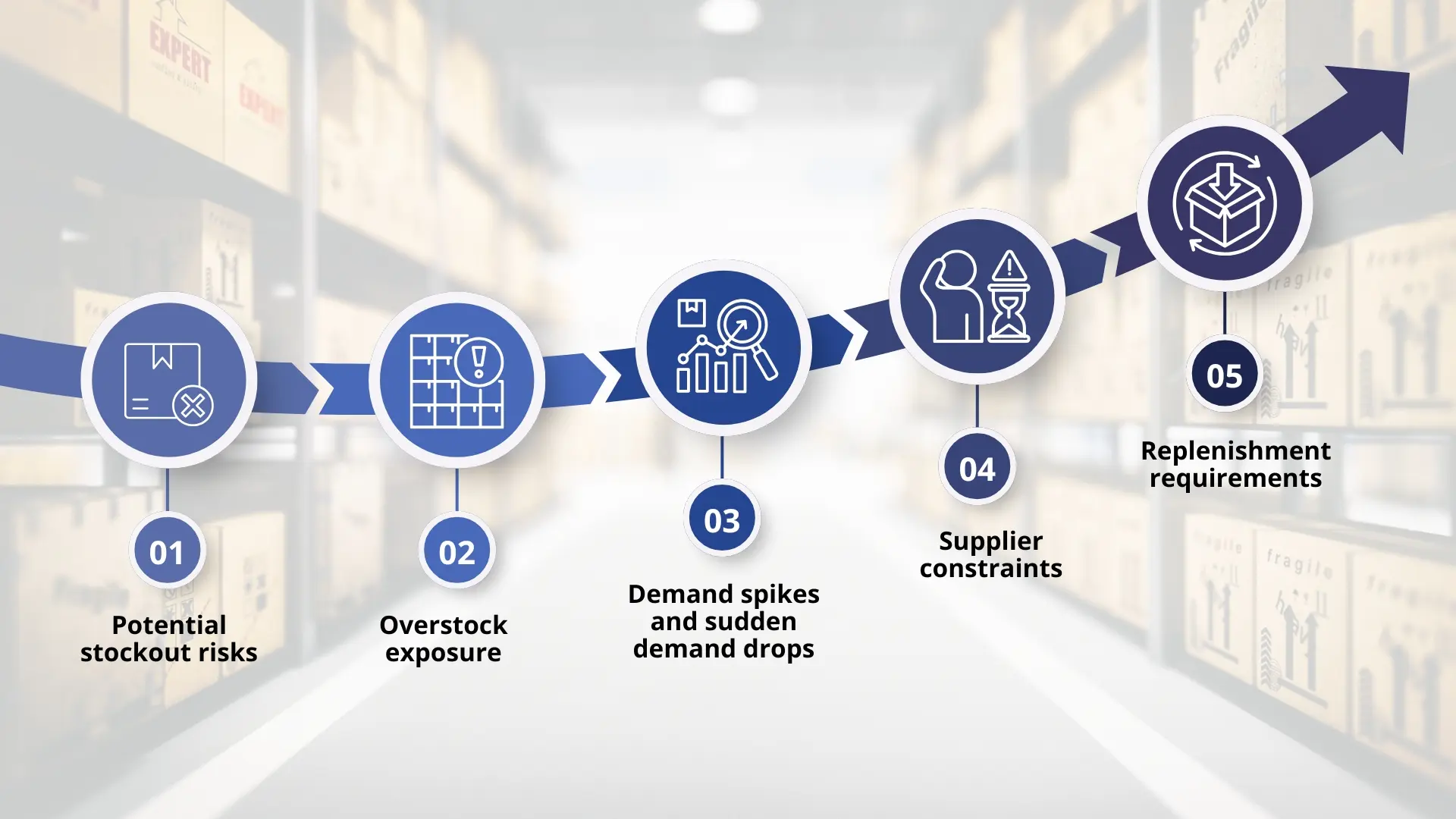
Rather than manually monitoring thousands of SKUs, they focus on situations that require immediate attention, such as :
planning-teams-best-practices
  • Potential stockout risks
  • Overstock exposure
  • Demand spikes and sudden demand drops
  • Supplier constraints
  • Replenishment requirements

This approach enables planners to prioritize business-critical decisions instead of spending valuable time gathering and reconciling data.

With SpectraONE, planners can proactively identify these exceptions, receive explainable forecasting insights with confidence indicators, and focus on the actions that have the greatest business impact.

Connecting Forecasts to Procurement

One of the biggest gaps in FMCG planning exists between forecasting and procurement.

In many organizations, demand planners generate forecasts while procurement teams manually translate those forecasts into purchase decisions. This often creates delays, inconsistent responses, and unnecessary inventory costs.

A more effective approach connects forecasting directly with inventory policies, supplier constraints, lead times, and replenishment requirements.

This is where decision intelligence delivers measurable value.

SpectraONE helps bridge this gap by translating demand forecasts into procurement recommendations based on inventory policies, stock coverage, lead times, supplier reliability, and replenishment needs. Instead of manually calculating reorder quantities, planners receive actionable recommendations that support faster and more consistent decision-making.

The Future of FMCG Planning 

The future of demand planning is not about generating more forecasts.

It is about creating a connected process that continuously predicts, evaluates, decides, acts, and learns.

Organizations are increasingly shifting their focus from forecast accuracy alone to broader business outcomes such as inventory optimization, faster response to demand changes, reduced manual effort, and improved collaboration between planning and procurement teams.

The planners who create the greatest value will not be those with the most sophisticated forecasts.

They will be the ones who can turn demand signals into timely, confident decisions.

Because in today’s FMCG environment, the real challenge is not predicting demand.

It’s knowing what to do next, and having the visibility and intelligence to act before small issues become major disruptions.

That’s why forward-looking FMCG organizations are moving beyond forecasting and adopting connected planning approaches that unify demand, inventory, and procurement decisions. SpectraONE is designed to support exactly that journey.

Why Are U.S. Drug Shortages Lasting Longer Than Ever in 2026?

On paper, the U.S. pharmaceutical supply chain looks like it is finally catching its breath. Look at the raw headlines, and you will see a noticeable drop in the total number of active drug disruptions across the country. But for hospital administrators, procurement teams, and patient care coordinators on the front lines, the reality on the ground feels entirely different.

The crisis hasn’t been solved; it has just changed shape.

According to the newly released USP 2026 Annual Drug Shortages Report, published by the United States Pharmacopeia [USP], the critical issue in 2026 isn’t just how many shortages are starting, but how long they linger. The average life science supply disruption now lasts over 5 years, a massive escalation from the 4.3-year average tracked in 2024.

When a missing life-saving medication transforms from a temporary operational hiccup into a half-decade-long blockade, it signals a deep, structural failure in the pharmaceutical ecosystem. To understand why these disruptions have become so stubborn, we have to look closely at the fragile economics of generic drug manufacturing and the extreme concentration of the global supply network.

The Problem at a Glance

The reduction in active U.S. drug shortages is a misleading metric. 

Shortages are lasting longer than ever because generic manufacturers are operating under extreme price compression, leaving them with zero economic buffer to absorb supply shocks or invest in factory upgrades. 

When these razor-thin margins clash with heavily concentrated global supplier networks, a single point of failure can freeze a critical product line for years.

The Margin Squeeze: Why Generic Makers Are Vulnerable

To understand the longevity of modern drug shortages, you have to look at the unique financial vise gripping the generic drug industry. Generic medications make up the vast majority of prescriptions filled in the United States, yet the companies producing them operate on razor-thin profit margins.

The Margin Squeeze_ Why Generic Makers Are Vulnerable

In a healthy market, a shortage creates a supply deficit, causing prices to rise, which naturally rewards suppliers who can bring new capacity online. But the generic drug market does not operate like a normal textbook economy. Driven by hyper-competitive group purchasing frameworks and a race-to-the-bottom on pricing, generic margins have been compressed down to pennies.

When a generic manufacturer experiences an operational issue such as a facility breakdown, a failed regulatory inspection, or a sudden spike in raw material costs, they face a devastating financial choice:

  1. No Capital for Contingencies

Because their profit margins are so narrow, these facilities rarely have excess capital sitting around to build redundant production lines, maintain deep safety stock buffers, or absorb sudden logistics cost increases.

  1. The Discontinuation Trap 

If fixing a compliance issue or sourcing an alternative ingredient costs more than the drug can fetch on the open market, manufacturers do the only logical thing left for a business, so they permanently stop making the drug altogether.

When a low-margin factory goes dark, other manufacturers cannot simply flip a switch to fill the void. Ramping up production lines for highly sensitive sterile injectables or complex oral solids requires millions of dollars in capital and months or even years of strict regulatory validation. 

As a result, the market stays empty, and the shortage clock keeps ticking year after year.

The Geographic Chokepoint: The U.S.–India Reliance

The second reason shortages are lasting longer than ever comes down to geographic concentration. The United States generic pharmaceutical pipeline relies heavily on a highly localized hub of global manufacturing.

The Geographic Chokepoint_ The USIndia Reliance 3

Today, India supplies roughly 45% to 47% of the total U.S. generic drug volume. This immense volume means that nearly half of the critical, everyday medications dispensed in American healthcare systems trace their roots back to Indian manufacturing clusters.

While this centralized footprint offers incredible economies of scale, it also introduces massive systemic vulnerabilities:

Upstream Vulnerabilities

Even when an Indian manufacturing facility is running perfectly, it frequently relies on single-source suppliers located in other regions for Key Starting Materials [KSMs] and Active Pharmaceutical Ingredients [APIs]. 

  • Regional climate event
  • Economic shift 
  • Regulatory block 

It hits those upstream chemical nodes, and the entire generic production line stalls.

The Lead-Time Echo

When an operational or logistical disruption happens thousands of miles away, the delay ripples across oceans. 

  • Re-routing raw materials 
  • Resolving international compliance actions 
  • Clearing shipping backlogs 

It takes a tremendous amount of time. Because the global pipeline is pulled so taut, there is simply no slack in the system to recover from a localized shock. 

When half of your market volume originates from a single global region, any systemic tremor there creates a long-lasting echo in U.S. medicine cabinets.

Moving Past Reactive Triage

For years, the healthcare industry has treated drug shortages like short-term emergencies using reactive triage, manual tracking spreadsheets, and emergency allocation protocols to shift boxes of medicine from one hospital to another.

But the data from the latest USP Annual Drug Shortages Report proves that the old way of managing supply chain risk is no longer sustainable. When shortages become multi-year fixtures, they stop being temporary crises and become the baseline reality of healthcare logistics.

Solving a five-year shortage problem requires the market to move past finished-goods tracking.

  • Look all the way upstream across the pharmaceutical supply chain
  • Gain deep visibility into multi-tier chemical suppliers
  • Understand the fragile economics of the factories that make our medicines
  • Build proactive diversification strategies before the next headline disruption arrives

Together, these actions are the foundation of true resilience in the drug supply chain. Read the full regulatory and economic breakdown by accessing the USP 2026 Annual Drug Shortages Report directly.

Multi-Enterprise Orchestration and the End of the N-Tier Visibility Gap

Most manufacturing and retail supply chains run on a fragile assumption. We assume that if our direct vendors are stable, our operations are secure. But the real vulnerabilities are rarely found at the surface. The real disruptions come from deeper down, the raw material processors and component suppliers you don’t even have contracts with.

The industry spent a fortune over the last decade chasing N-Tier Visibility. Yet, simply watching a disruption happen isn’t the same as fixing it. Knowing a shipment is stuck at sea just gives your team a front-row seat to an inevitable stockout. If you want to protect your margins, you have to move past basic tracking. You need a system that can actually intervene across corporate boundaries.

What is Multi-Enterprise Orchestration

Think of multi-enterprise orchestration as an automated logic layer that coordinates decisions across completely separate companies.

Your legacy ERP handles what happens inside your own building. Multi-enterprise orchestration handles the messy handoffs between you, your suppliers, your contract factories, and your logistics providers. When something breaks upstream, this layer calculates the downstream impact on your inventory levels and immediately changes purchase orders, production queues, and shipping routes across your entire external network simultaneously.

What is Multi-Agent Orchestration

Don’t confuse Multi-Enterprise Orchestration business outcome with Multi-Agent Orchestration. That is the actual software architecture running under the hood.

Multi-Enterprise

Instead of using one massive, slow software program to solve an operational problem, a multi-agent framework deploys a network of small, highly specialized digital “agents.” Each agent has one job. One tracks port wait times, another watches factory capacity, a third audits warehouse space, and a fourth monitors carrier pricing.

These digital workers don’t sit in silos. They constantly talk, negotiate, and swap data with each other in milliseconds to solve multi-variable problems. Multi-agent architecture is the technical engine; multi-enterprise orchestration is the external network of companies that the engine keeps in sync.

The Economics of Upstream Failure

To strip away the IT jargon, look at this through a simple, everyday operational lens: 

A school cafeteria is preparing 500 meals for a hard noon deadline.

Your primary partner is the local bakery that delivers the bread rolls every morning (Tier 1). 

The bakery relies on a regional mill for its flour (Tier 2). 

The mill relies on a farming cooperative to harvest the wheat (Tier 3).

If you run a standard visibility setup, you might get an automated email at 6:00 AM stating that a severe storm has halted the wheat harvest. The data is perfectly accurate. But you still don’t have lunches for 500 people. The bakery is about to run out of flour, and your team is facing hours of frantic phone calls, manual spreadsheet overrides, and emergency menu pivots.

For a second, stop and audit your current workflow. 

  • When a sub-tier component fails in your actual supply chain, how long does it take for your planners to find out? 
  • Do you catch it at the source, or do you inherit the crisis days later when a critical delivery simply fails to show up at your warehouse dock? 
  • Who pays for the labor hours spent hunting down alternatives?

An orchestrated system, backed by a multi-agent engine, completely changes this timeline. The moment the storm hits the fields, the Supply Monitoring Agent flags the harvest delay. It doesn’t just alert a human; it immediately passes the data to the Production Agent, which calculates how long the bakery can run on its current flour reserves. Simultaneously, the Sourcing Agent scans regional suppliers, finds a mill with unallocated safety stock, and reroutes a backup flour order to the bakery.

The cafeteria experiences zero downtime because the software agents negotiated a fix across three separate businesses before your primary supplier’s production line ever ground to a halt.

Overcoming the Data Sharing and Privacy Deadlock

This level of deep network connectivity always hits a major roadblock: 

Why on earth would a third-party supplier give you access to their private operational data? 

It is a completely reasonable objection

Upstream vendors protect their internal numbers. They worry that total transparency will give you too much leverage during price negotiations or expose their own internal operational flaws during contract renewals. If you asked your current manufacturers for a live, unedited look at their sub-vendor capacity logs today, you would likely spend 6 months locked in data privacy legal reviews.

We bypass this deadlock through a signal-based architecture called the Digital Handshake. The platform doesn’t require direct integration with a supplier’s core database; instead, it hooks into secure, encrypted connection points that exchange specific operational pulses rather than raw commercial records. 

Your vendors keep their data private; they simply broadcast automated availability signals and lead-time variations specific to the SKUs you buy.

By deploying a platform like SpectraONE as an independent layer, you can monitor ETA Variability across organizational borders. The handshake ensures that when an exception threshold is crossed, the multi-agent system runs a pre-mapped backup plan without forcing either company to expose their sensitive business secrets.

Replacing Buffer Inventory with Continuous Material Flow

The ultimate goal of orchestrating an extended supplier base is continuous, uninhibited material flow. When your deep-tier risks are handled by an Agentic AI layer, you can systematically draw down the bloated safety stock cushions that quietly drain capital from your balance sheet.

Buffer Inventory with Continuous Material Flow

Companies who relying on static dashboards remain fundamentally reactive, documenting logistics failures after they have already damaged quarterly performance. Actual competitive advantage belongs to the operations teams that can out-execute the delay itself.

How much cash is currently trapped in your inventory buffers simply because your software can’t execute an action without a human clicking ‘approve’?

Long-term profitability in a volatile global market isn’t about the sheer volume of data you collect. It depends entirely on the Decision Velocity you can apply to your entire multi-enterprise network.