
Why Stockouts and Overstock Come From the Same Place: Webinar Recap

In short: Stockouts and overstock usually come from the same place: stock sitting in the wrong location and decisions made too late. Three supply chain leaders from Mankind Pharma, Kwality Global and Hocco Ice Creams explain how they balance service level and working capital, and a live demo shows a forecast turning into an approved purchase order.
On 25 September we hosted a live webinar on a problem most planning teams know well: stockouts and overstock showing up in the same company in the same month. Rahul Aulak, Head of Product & Business at SpectraONE, hosted three supply chain leaders from Mankind Pharma, Kwality Global and Hocco Ice Creams. They covered service level, working capital, and what to do when demand moves before the report does.
Want the whole session? The 60-minute recording includes the panel, the demo and every audience question. Watch the full recording →
What the panel said about stockouts and overstock
1. A company can hold plenty of stock and still run out
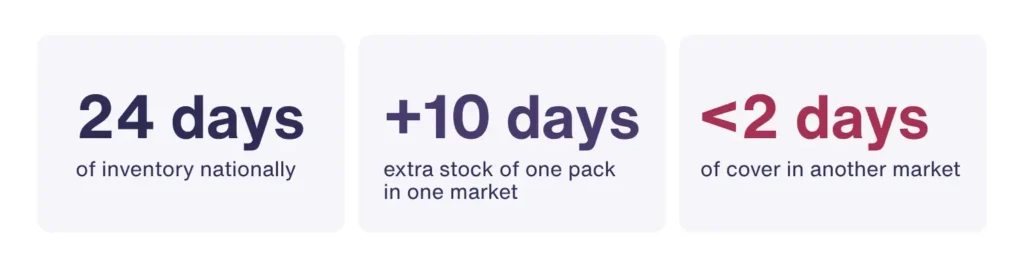
Hari Krishnan, Head of Supply Chain at Hocco Ice Creams, started with a number. The company held about 24 days of inventory nationally. Yet one market sat on 10 extra days of a pack while another had under two days of cover. A mango family pack was sitting in Ahmedabad while demand jumped in Surat, and shoppers in Surat found empty shelves.
“Success is not about carrying more inventory,” Hari said. “It’s about having the stocks at the right place.”
Stockouts and overstock, in other words, are an inventory placement problem before they are a quantity problem.
2. Every industry ranks service level and working capital differently
Arun, Deputy General Manager at Mankind Pharma, puts availability first, and he gave reasons. Gross margins are above 70%. A missed delivery can mean a patient goes without medicine. On chronic medicines such as blood pressure or diabetes tablets, he shared a candid perspective “If you lose a customer, you lose them forever.” The largest player holds no more than 5% of the market, and a product can be banned in a single day.
So pharma carries more than 60 days of inventory, against 20 to 40 in FMCG. His order is service level first, inventory second, and everything else after that.
3. When stock is short, channel rules decide who gets served
Shubham Mukhopadhyay of Kwality Global explained how his team orders when they can’t fill them all. They prioritize modern trade, then ecommerce, then mini modern trade, and finally general trade.
The reason is timing. Modern trade and ecommerce buy on local purchase orders with a 24-hour delivery window, stretched to 36 at most. After that, the customer closes the order with zero delivered. A supplier who misses one or two gets pushed down the list.
Exports work the same way. A gap in Muscat is easy to fill from Dubai. A gap in Riyadh is not easy to fill. The decision depends on paperwork and the extra sales at stake. It also depends on how fast a truck can get there.
4. Demand moves faster than the sales report
Stockouts and overstock both grow when the signal arrives late. Hari said ice cream demand can shift 20 to 30% within days because of weather, holidays or a promotion. If a top SKU jumps 30% and the distributor holds two to four days of safety stock, the buffer is gone fast.
“By the time the sales report confirms that there is an issue,” Hari said, “we have already lost sales for several days.” He puts the lag at five to seven days.
Rahul gave a simple picture of the cost. A signal that arrives 30 days ahead lets you move stock cheaply, and one that arrives 15 days ahead costs more. That is why local demand forecasting matters, and why Hari’s first move in a spike is to transfer stock before making more. If one depot holds 12 days of a product and another holds 3, moving it beats extra production or double freight.
5. Pick one goal per season, and review only what moved
Rahul asked whether the answer to a spike is to produce more, move stock, change allocation or protect a priority market. Shubham said planners do all four at the same time. “It’s not or, it’s and.”
On service level versus inventory cost, though, he advised against chasing both in one season. For ice cream, that means case fill rate and service level first from April to September, then inventory correction from October.
Arun keeps the workload manageable with an exception review twice a month. His team compares month-to-date sales with the forecast and corrects only the SKUs that moved, about 10% of the range at most. He said accuracy at the SKU and distribution center level reaches 80%, with about 70% of stock held close to customers and 30% in a central buffer.
Why fixed rules cause stockouts and overstock
In his short talk before the demo, Rahul named three habits that slow teams down. Priority rules stay fixed while lead times change. Safety stock gets set once and left alone. And plans look 30, 90 or 365 days ahead when buyers now ask for delivery within 24 hours.
His answer was dynamic safety stock, reorder points that move with lead times, and weekly rolling forecasts alongside the longer ones. Shubham agreed, adding that e-commerce and quick commerce have made the bullwhip effect much bigger.
What the demo showed
Deepti Singh walked through one flow from start to finish on sample data. SpectraONE pulled sales orders from SAP/HANA and forecast the next 10 days for each SKU and region. It tested five or six forecasting models and kept the one with the lowest error, which was random forest this time.
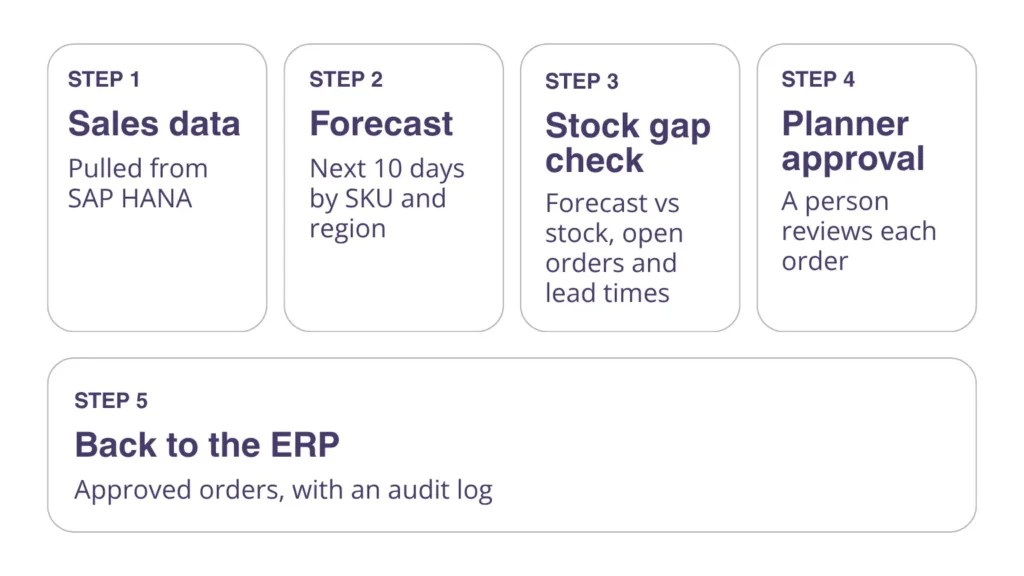
A procurement agent then compared the forecast with stock, open purchase orders and supplier lead times, and listed the gaps. A planner reviewed the suggested purchase orders and approved them. The approved orders went back into the ERP with an audit log of each step. The whole thing ran as one flow, and a person made the final call.
Meet the speakers

Your questions, answered
Should an e-commerce business plan at SKU level or by size, colour and design?
It depends on when the shopper’s choice becomes fixed. Arun said that if a product can stay generic until late, you can plan at a grouped level. If shoppers pick a specific variant at checkout, you have to plan at SKU level. Hari added that stocking every variant lifts availability but pushes up working capital, while holding common base items and finishing to order sits in the middle with a longer lead time.
How do you build an inventory model that balances availability and working capital?
Arun called it an optimization problem. Fix a service level first, such as 90% or 95%, because 100% needs endless stock. Then plan replenishment to meet it and compare best-case, worst-case and expected-case scenarios on top of the forecast, including sales overrides. Good inventory optimization starts with that choice.
How do you track demand swings without driving up cost?
Hari said his team doesn’t react to every hourly change, but it reviews daily demand signals, stock at the factory, depots and distributors, and secondary sales. The first lever is repositioning stock. It costs something, but less than extra production or double freight.
How do you spot overstock before it turns into expiry?
Arun said stock that builds for two to three months with no repeat orders from the same area is the warning sign. His team pulls it back and redistributes it, and also watches secondary sales and stockist inventory so that pushing stock into the market doesn’t come back as expired returns. He said this keeps expiry returns under 1.2%.
Does SpectraONE work with the ERP we already run?
Yes. Deepti explained that SpectraONE connects to existing systems such as ERP, WMS and TMS through lightweight integrations. SpectraONE is an AI Supply Chain Intelligence Platform that adds a planning and intelligence layer on top of the ERP you already run. It works with SAP, Oracle, NetSuite and Microsoft Dynamics, and you can also upload CSV or Excel files.
Next step
If your team still builds replenishment decisions from ERP exports and spreadsheets, a focused use case on your own data is the quickest way to see where stockouts and overstock start in your planning.