
ERP Lead Time Crises: How to Fix Electronics Supply Risk

Managing a modern electronics manufacturing supply chain involves a costly operational contradiction. Your enterprise likely invested heavily in an advanced ERP platform to optimize schedules. Yet, planners still manage critical parts of pipelines out of disconnected spreadsheets. Legacy databases regularly trigger severe MRP lead time failures because they rely on fixed, static data. This article explores how hidden component lead time volatility causes semiconductor component shortages and how to permanently correct your baseline ERP lead time errors.
When electronic component delivery windows suddenly balloon from 12 weeks to 40 weeks, legacy inventory calculation models crash. That doesn’t mean your software is broken; its core database architecture was simply never designed to handle the external volatility inherent in modern global electronics logistics. To eliminate “lines-down” emergencies and reclaim your working capital, you need to understand exactly why your transactional software falls short and how to deploy a targeted intelligence layer to fix it.
| Summary Core transactional systems fail to predict component shortages because they are structurally built around static, internal parameters. For example: • When global foundry allocations shift • When tier-two raw material bottlenecks occur In both cases, an ERP remains completely blind to the delay until a delivery is missed. True resilience requires augmenting your existing transactional database with real-time external risk-sensing software like SpectraONE to dynamically adjust planning inputs before supply shocks hit your production line. |
Why Do Standard ERP Lead Time Calculations Fail?
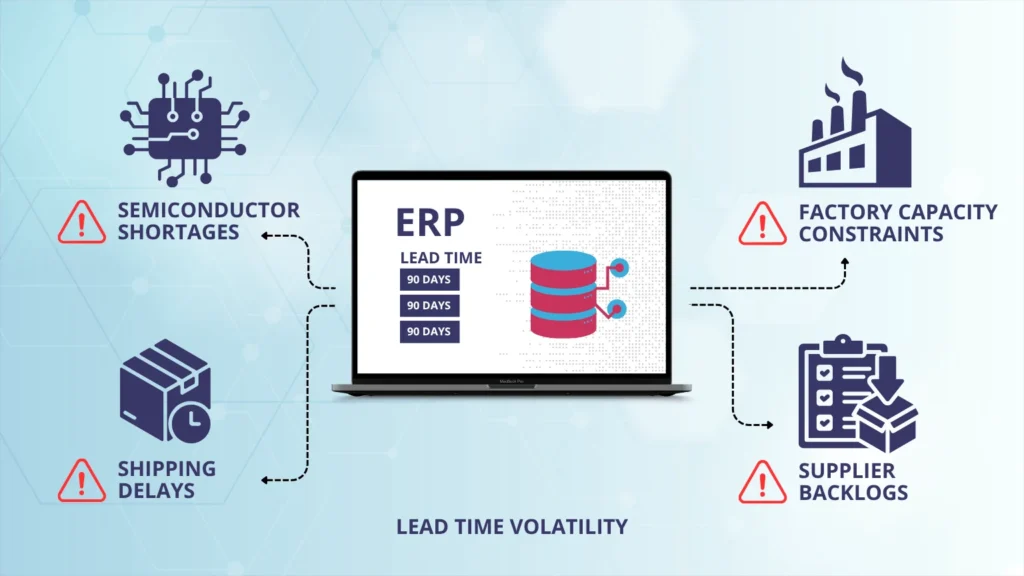
When a supply chain leader searches for a solution to inventory shortages, the root cause usually comes down to a fundamental software design flaw: ERPs operate inside a walled garden. Traditional Material Requirements Planning [MRP] engines trigger purchase orders using rigid mathematical formulas. First, the system checks internal historical sales trends. Next, it looks at current inventory records inside your warehouse management system [WMS]. Finally, it multiplies those numbers against the static value hardcoded into your material master files.
| [Static Hardcoded Lead Time] x [Internal Historical Demand] = Flawed Purchase Order Timing |
This logic works perfectly for stable, locally sourced commodities. However, it fails completely when applied to specialized electronics components like integrated circuits [ICs], custom microcontrollers, or multi-layered ceramic capacitors [MLCCs].
Here is why:
- The Fallacy of the Fixed Field: An ERP treats lead time as a static parameter (e.g., 90 days). In reality, electronic component lead times are highly fluid, fluctuating daily based on global silicon wafer fabrication utilization, factory capacity allocations, and international shipping capacity.
- The Backward-Looking Blind Spot: Your ERP’s data horizon is entirely internal and backward-looking. It knows when you placed past orders, but it has zero real-time visibility into the order backlogs of global semiconductor manufacturers or tier-two raw chemical suppliers.
Because your system cannot “sense” market signals outside its own database, it continues to execute purchase triggers based on outdated assumptions. By the time your system registers that a lead time has lengthened, the manufacturing gap has already closed, leaving your procurement team stranded in a multi-month vendor allocation backlog.
What happens to electronics manufacturing logistics when MRP lead times fail?
When material planners realize that the automated inventory schedules generated by their enterprise software are consistently inaccurate, it triggers an immediate psychological shift: system distrust. To protect the factory floor from running out of parts, planners take matters into their own hands, creating a cascade of hidden operational costs.
1. The Proliferation of Manual “Shadow IT”
To bypass inaccurate system dates, procurement teams export critical bills of materials into manual offline spreadsheets. This breaks your organization’s single source of truth. Suddenly, finance is forecasting cash flow based on ERP metrics, while procurement is purchasing materials based on unvalidated desktop calculations, leading to mass misalignment.
2. Artificial Safety Stock Inflation and Capital Lockup
To ease the constant anxiety of a “lines-down” emergency, planners begin manually padding their lead-time fields, adding arbitrary “buffer weeks” to every component order. This defensive ordering behavior creates an artificial bullwhip effect across your network. Your warehouse fills up with millions of dollars of raw material inventory you don’t immediately need, locking up vital working capital while you still run out of the one critical chip required to complete the build.
3. Severe SLA Erosion and Margin Penalties
In electronics assembly, a product cannot be shipped if it is missing a single surface-mount component. When a long lead-time part fails to arrive, partial assemblies pile up on the warehouse floor, work-in-progress [WIP] inventory spikes, and finished goods shipments stall. This directly damages your customer service level agreements [SLAs], forcing contract manufacturers to absorb expensive expedited shipping fees, client penalties, and lost future revenue.
| MRP Failure ➔ System Distrust ➔ Spreadsheet Proliferation ➔ Inaccurate Buying ➔ Inflated Safety Stock & Lines Down |
Combat Component Lead Time Volatility with Supply Chain Intelligence

Fixing this structural gap does not require you to undergo another multi-million-dollar, disruptive system migration. You do not need to replace your ERP; you simply need to change how it receives its operational parameters. Forward-thinking manufacturing organizations are solving this issue by deploying SpectraONE, an advanced supply chain intelligence overlay designed to bridge the gap between internal transactional execution and external market realities.
SpectraONE integrates directly on top of your existing IT infrastructure. By deploying real-time lead time risk sensing, our platform transforms your planning process from a reactive guessing game into an active, data-driven operation. This overlay provides targeted capabilities:
| [SpectraONE Real-Time Lead-Time Risk Sensing] ➔ Updates Input Variables ➔ [Existing ERP/MRP Executes Correctly] |
Proactive Lead-Time Risk Sensing
Instead of relying on the static historical averages saved inside your material master files, SpectraONE actively analyzes in real time:
• External supply signals
• Vendor capacity indices
• Macroeconomic logistics variables
The platform senses dynamic lead-time variances weeks before your standard scheduling engine is set to run. By flagging these adjustments early, SpectraONE gives your material planners the runway needed to:
• Adjust order parameters
• Advance purchase triggers
Before a global bottleneck chokes off your component supply.
Real-Time Alternate Sourcing Visibility
Sensing a future component shortage is only half the battle; procurement teams must also be empowered to act instantly. When SpectraONE detects an upcoming lead time blowout or vendor allocation risk, it automatically provides visibility into:
• Alternative supply networks
• Secondary distribution channels
This gives your sourcing specialists the real-time insights required to:
• Rapidly diversify their procurement strategies
• Secure secondary allocation pools
Maintain complete product continuity, entirely avoiding the manual search processes that slow down traditional operations.
By augmenting your foundational transactional database with SpectraONE‘s specialized risk-sensing and alternative sourcing intelligence, you can eliminate system distrust, protect thin manufacturing margins, and ensure your working capital is always optimized for maximum inventory turn.