
AI Backorder Management for High-Tech Manufacturers

Backorder management is the process of prioritizing, allocating, and fulfilling orders when inventory is temporarily unavailable. AI-powered backorder management can strengthen supply chain optimization by helping high-tech manufacturers protect margins, customer commitments, and fulfillment performance during demand spikes. 

During peak cycles, component delays and demand surges can trigger costly reactive interventions, including air freight, chargebacks, and missed deliveries. Traditional systems provide planning and visibility, but they may not consistently compare response options based on revenue, service, and margin impact. 

This article explains how SpectraONE adds an AI decision layer across existing enterprise supply chain systems. It can help teams identify backorder risks, compare response options, and coordinate allocation decisions based on service, revenue, and margin priorities.

Backorder Management and Supply Chain Optimization for Peak Season  

Effective backorder management connects available-to-promise inventory, inbound supply, allocation rules, and customer communication. With AI-supported decisions, manufacturers can improve supply chain optimization, reduce avoidable expediting, and protect margins when demand peaks. 

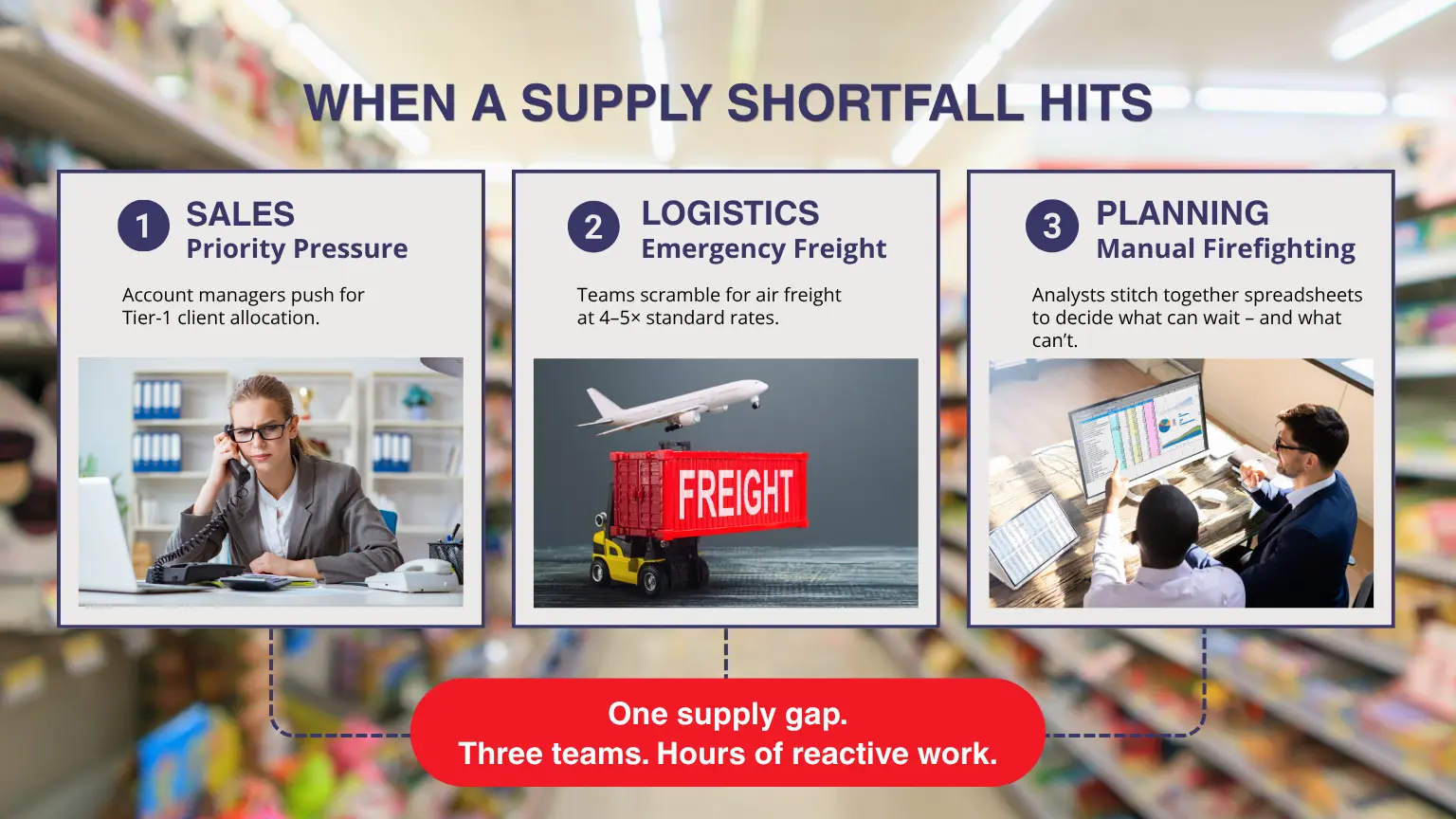
A delay in critical microcontroller deliveries can affect production of a high-margin flagship product. The implications extend across production schedules, inventory allocation, customer commitments, and shipping decisions.
1

Manual coordination across teams can extend decision timelines, increase reliance on expedited freight, and leave key distributor orders only partially fulfilled. During peak season, frequent stockout interventions reduce time for strategic planning. Proactive alerts, coordinated allocation, and clear customer updates help teams maintain service levels and protect margins.

The Hidden Legacy Gap: Why Enterprise Systems Fall Short in a Crunch

Enterprise systems provide the operational foundation for managing orders, inventory, and transactions. During supply disruptions, teams also need to evaluate allocation choices across customer commitments, product margins, and delivery priorities. Connecting this data to coordinated decisions helps them assess trade-offs and choose an appropriate fulfillment response. 

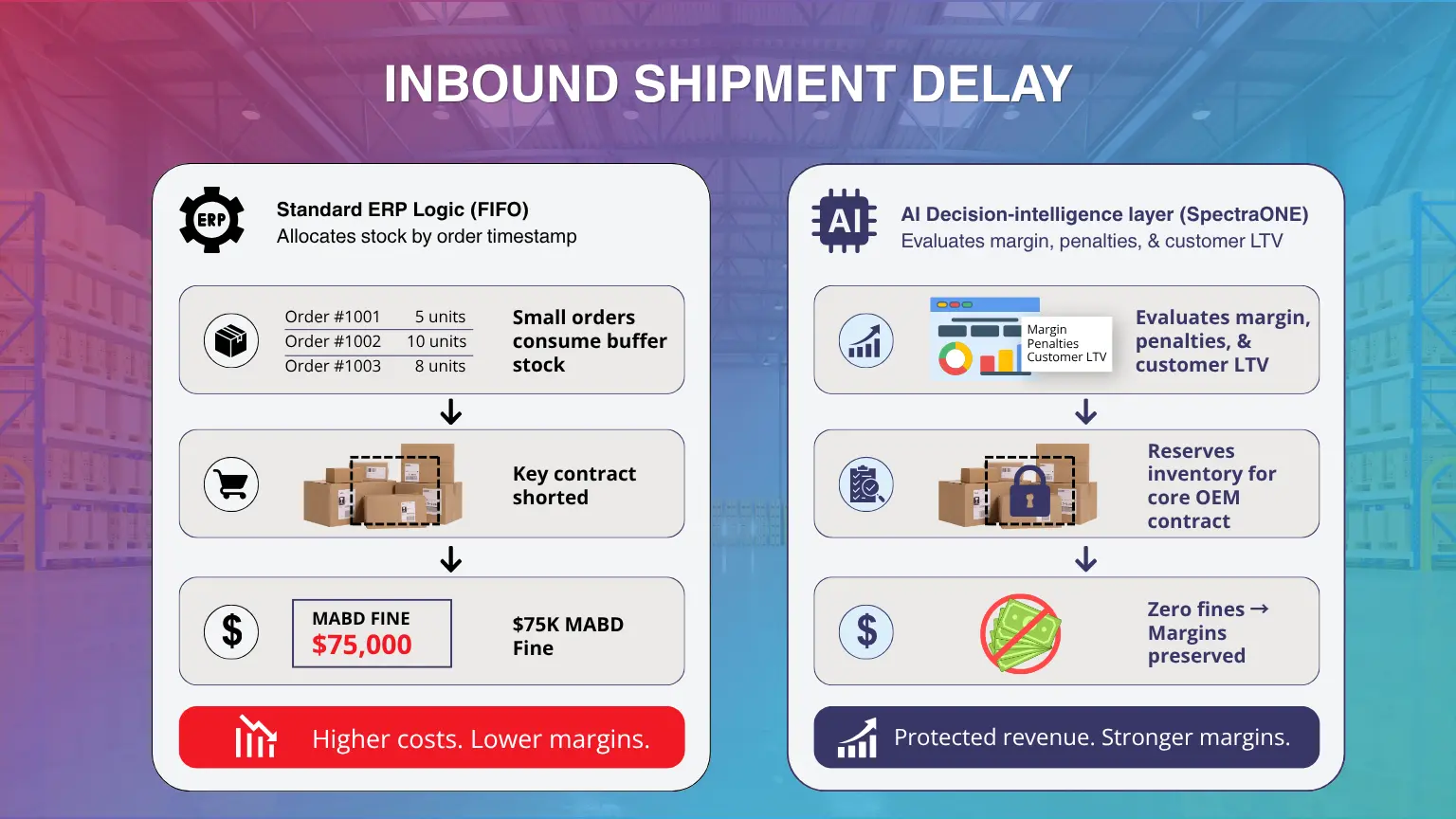
When orders are prioritized solely by receipt time, allocation decisions may overlook customer value, contractual commitments, and profit contribution. Incorporating these factors helps teams align fulfillment priorities with business objectives.
2

For example, when a delayed shipment reaches a distribution center, an ERP configured to allocate inventory by order date may assign units to the earliest order. A small web order could then consume microprocessors needed for a high-value Tier-1 OEM contract.

If the manufacturer identifies the resulting shortage after the enterprise delivery window closes, it may face Must-Arrive-By Date (MABD) chargebacks and emergency expediting. Enterprise systems are not necessarily broken; they may lack a real-time, margin-aware decision layer to guide allocation during stockouts.

5-Step AI Backorder Management Workflow 

Implementing decision intelligence does not necessarily require replacing existing IT infrastructure. A platform such as SpectraONE can connect with enterprise systems to support the following five-step workflow:

Step 1: Revenue Impact Analysis  

Instead of sorting the backlog only by calendar date, AI can categorize pending orders based on:

  • Total profit contribution 
  • Customer SLA terms 
  • Penalty exposure 

Allocation rules can prioritize key enterprise accounts for incoming stock based on SLAs, margin impact, and penalty exposure.

Step 2: Multi-Echelon Network Sourcing

When a primary distribution center experiences a stockout, the platform can evaluate alternative inventory sources across the network, including: 

  • Regional hubs 
  • 3PL facilities
  • In-transit stock 

The system can then identify alternative fulfillment options before planners authorize expensive air freight.

Step 3: Predictive SLA Safeguards

Predictive algorithms can provide early warnings by: 

  • Tracking carrier progress.
  • Flagging potential transit breaches in advance.

These alerts give planners time to reroute shipments proactively.

Step 4: Dock-to-Door Cross-Docking

In a cross-docking workflow, teams can tag backordered components upon arrival. The goods can bypass storage and move directly from receiving to outbound staging.

Step 5: Closed-Loop Root-Cause Learning

The system can analyze disruption patterns, supplier lead-time variances, and transit bottlenecks. Teams can use these insights to refine ERP planning parameters and address recurring backorder causes before future peak cycles.

Backorder Management KPIs and Daily Operations

To evaluate backorder management performance, teams should track backorder age, fill rate, cancellation rate, past-due commitments, expediting costs, and promise-date accuracy. An AI-powered operational assistant can bring these measures into daily workflows and help planners focus on the highest-impact exceptions.
Blog-High-Tech Supply Chain Optimization
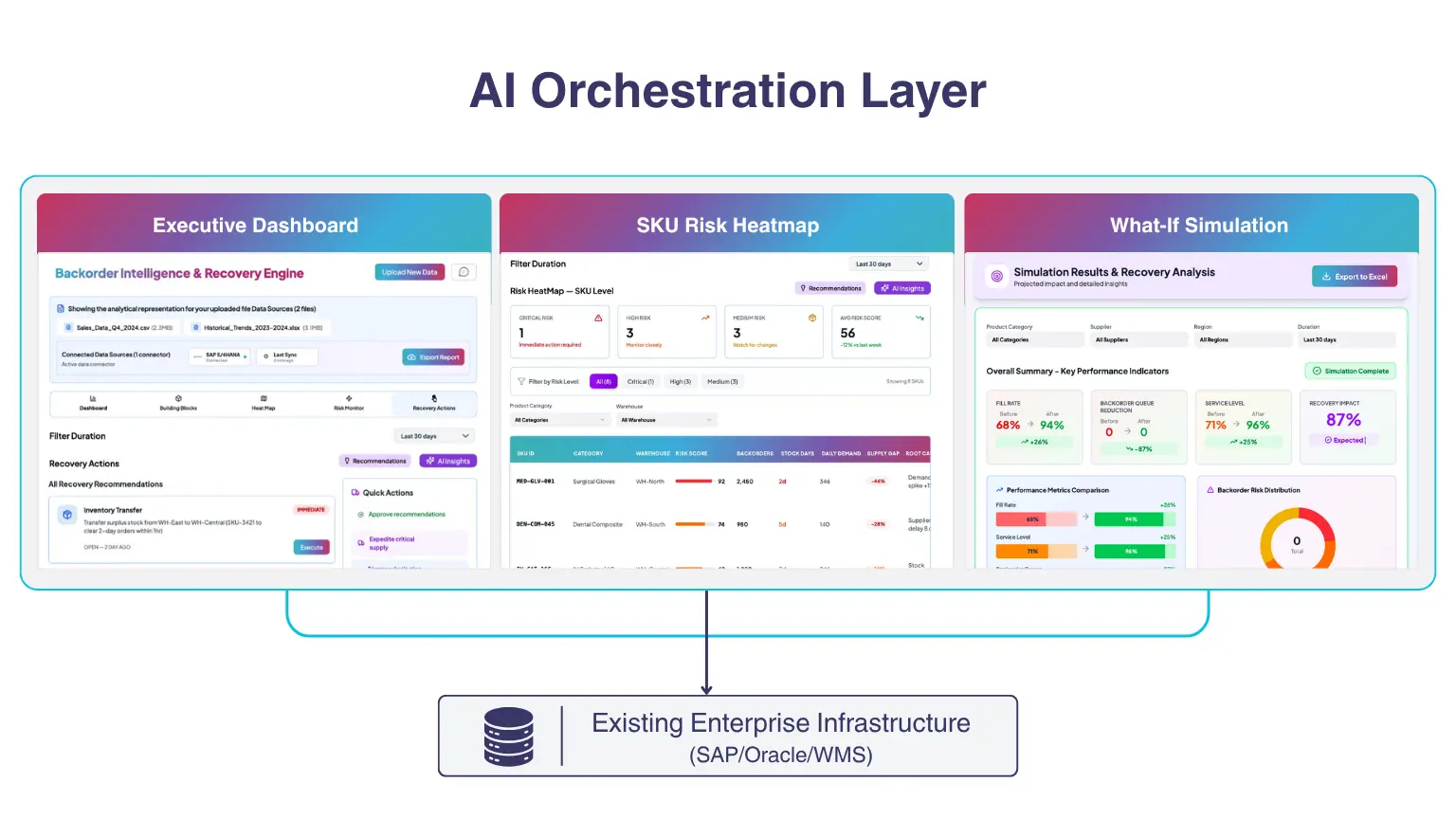
  • An executive dashboard can provide a unified view of inventory health, active backorder risks, financial exposure, and key performance indicators across product lines.
  • SKU risk heatmaps can highlight at-risk SKUs across regional distribution hubs so planners can focus on high-impact inventory and fulfillment exceptions.
  • What-if scenario simulations can help planners compare logistics costs, service outcomes, and margin implications before approving inventory transfers or expedited shipments.

Improve Backorder Management with Decision Intelligence

Peak-season demand in the high-tech sector will remain complex, but it doesn’t have to lead to constant reactive problem-solving. Augmenting existing enterprise systems with AI-driven decision intelligence can help teams coordinate backorder management, evaluate trade-offs, and move toward more proactive operational control.

SpectraONE is designed to provide visibility, automation, and decision support that can help teams protect margins, serve key partners, and manage peak demand more predictably.

Frequently Asked Questions

What is backorder management?

Backorder management coordinates inventory, incoming supply, order allocation, and customer commitments when products are temporarily unavailable.

How can AI improve backorder management?

AI can identify high-risk orders, compare fulfillment options, prioritize inventory, and alert teams to potential delivery delays.

How does backorder management support supply chain optimization?

Effective backorder management improves inventory allocation, reduces avoidable expediting, and helps teams maintain service levels during supply disruptions.

Which backorder management KPIs should teams track?

Key metrics include backorder age, fill rate, cancellation rate, expediting costs, past-due commitments, and promise-date accuracy.

Why Stockouts and Overstock Come From the Same Place: Webinar Recap

In short: Stockouts and overstock usually come from the same place: stock sitting in the wrong location and decisions made too late. Three supply chain leaders from Mankind Pharma, Kwality Global and Hocco Ice Creams explain how they balance service level and working capital, and a live demo shows a forecast turning into an approved purchase order.

On 25 September we hosted a live webinar on a problem most planning teams know well: stockouts and overstock showing up in the same company in the same month. Rahul Aulak, Head of Product & Business at SpectraONE, hosted three supply chain leaders from Mankind Pharma, Kwality Global and Hocco Ice Creams. They covered service level, working capital, and what to do when demand moves before the report does.

Want the whole session? The 60-minute recording includes the panel, the demo and every audience question. Watch the full recording →

What the panel said about stockouts and overstock

1. A company can hold plenty of stock and still run out

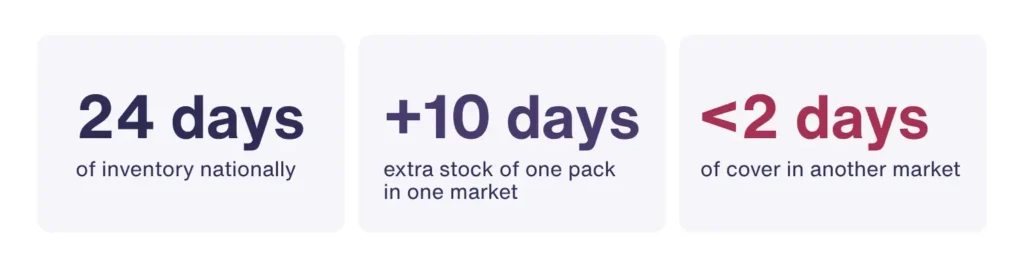
Hari Krishnan, Head of Supply Chain at Hocco Ice Creams, started with a number. The company held about 24 days of inventory nationally. Yet one market sat on 10 extra days of a pack while another had under two days of cover. A mango family pack was sitting in Ahmedabad while demand jumped in Surat, and shoppers in Surat found empty shelves.

24days

“Success is not about carrying more inventory,” Hari said. “It’s about having the stocks at the right place.”

Stockouts and overstock, in other words, are an inventory placement problem before they are a quantity problem.

2. Every industry ranks service level and working capital differently

Arun, Deputy General Manager at Mankind Pharma, puts availability first, and he gave reasons. Gross margins are above 70%. A missed delivery can mean a patient goes without medicine. On chronic medicines such as blood pressure or diabetes tablets, he shared a candid perspective “If you lose a customer, you lose them forever.” The largest player holds no more than 5% of the market, and a product can be banned in a single day.

So pharma carries more than 60 days of inventory, against 20 to 40 in FMCG. His order is service level first, inventory second, and everything else after that.

3. When stock is short, channel rules decide who gets served

Shubham Mukhopadhyay of Kwality Global explained how his team orders when they can’t fill them all. They prioritize modern trade, then ecommerce, then mini modern trade, and finally general trade.

The reason is timing. Modern trade and ecommerce buy on local purchase orders with a 24-hour delivery window, stretched to 36 at most. After that, the customer closes the order with zero delivered. A supplier who misses one or two gets pushed down the list.

Exports work the same way. A gap in Muscat is easy to fill from Dubai. A gap in Riyadh is not easy to fill. The decision depends on paperwork and the extra sales at stake. It also depends on how fast a truck can get there.

4. Demand moves faster than the sales report

Stockouts and overstock both grow when the signal arrives late. Hari said ice cream demand can shift 20 to 30% within days because of weather, holidays or a promotion. If a top SKU jumps 30% and the distributor holds two to four days of safety stock, the buffer is gone fast.

“By the time the sales report confirms that there is an issue,” Hari said, “we have already lost sales for several days.” He puts the lag at five to seven days.

Rahul gave a simple picture of the cost. A signal that arrives 30 days ahead lets you move stock cheaply, and one that arrives 15 days ahead costs more. That is why local demand forecasting matters, and why Hari’s first move in a spike is to transfer stock before making more. If one depot holds 12 days of a product and another holds 3, moving it beats extra production or double freight.

5. Pick one goal per season, and review only what moved

Rahul asked whether the answer to a spike is to produce more, move stock, change allocation or protect a priority market. Shubham said planners do all four at the same time. “It’s not or, it’s and.”

On service level versus inventory cost, though, he advised against chasing both in one season. For ice cream, that means case fill rate and service level first from April to September, then inventory correction from October.

Arun keeps the workload manageable with an exception review twice a month. His team compares month-to-date sales with the forecast and corrects only the SKUs that moved, about 10% of the range at most. He said accuracy at the SKU and distribution center level reaches 80%, with about 70% of stock held close to customers and 30% in a central buffer.

Why fixed rules cause stockouts and overstock

In his short talk before the demo, Rahul named three habits that slow teams down. Priority rules stay fixed while lead times change. Safety stock gets set once and left alone. And plans look 30, 90 or 365 days ahead when buyers now ask for delivery within 24 hours.

His answer was dynamic safety stock, reorder points that move with lead times, and weekly rolling forecasts alongside the longer ones. Shubham agreed, adding that e-commerce and quick commerce have made the bullwhip effect much bigger.

What the demo showed

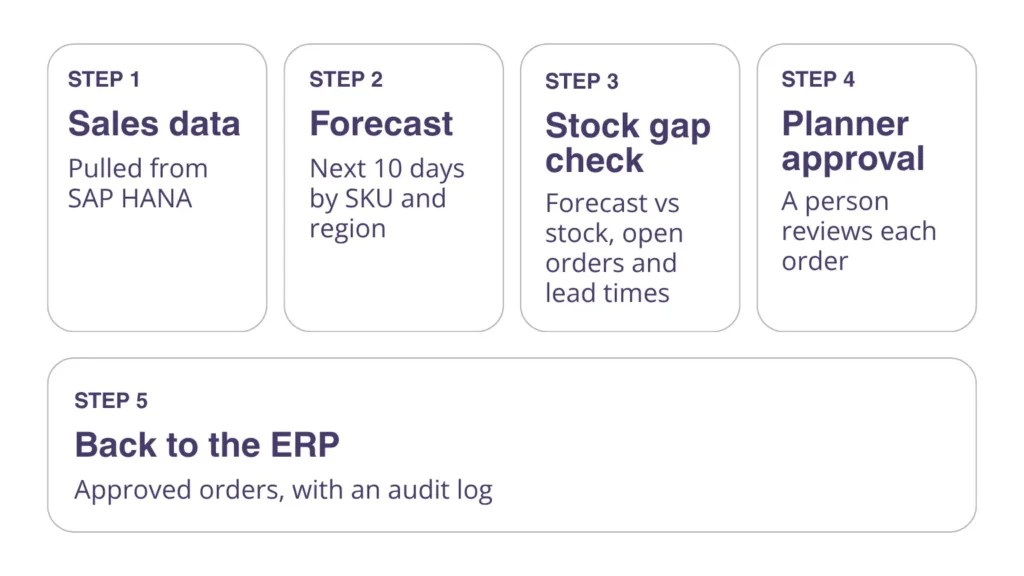
Deepti Singh walked through one flow from start to finish on sample data. SpectraONE pulled sales orders from SAP/HANA and forecast the next 10 days for each SKU and region. It tested five or six forecasting models and kept the one with the lowest error, which was random forest this time.

2

A procurement agent then compared the forecast with stock, open purchase orders and supplier lead times, and listed the gaps. A planner reviewed the suggested purchase orders and approved them. The approved orders went back into the ERP with an audit log of each step. The whole thing ran as one flow, and a person made the final call.

Meet the speakers

Webinar Blog

Your questions, answered

Should an e-commerce business plan at SKU level or by size, colour and design?

It depends on when the shopper’s choice becomes fixed. Arun said that if a product can stay generic until late, you can plan at a grouped level. If shoppers pick a specific variant at checkout, you have to plan at SKU level. Hari added that stocking every variant lifts availability but pushes up working capital, while holding common base items and finishing to order sits in the middle with a longer lead time.

How do you build an inventory model that balances availability and working capital?

Arun called it an optimization problem. Fix a service level first, such as 90% or 95%, because 100% needs endless stock. Then plan replenishment to meet it and compare best-case, worst-case and expected-case scenarios on top of the forecast, including sales overrides. Good inventory optimization starts with that choice.

How do you track demand swings without driving up cost?

Hari said his team doesn’t react to every hourly change, but it reviews daily demand signals, stock at the factory, depots and distributors, and secondary sales. The first lever is repositioning stock. It costs something, but less than extra production or double freight.

How do you spot overstock before it turns into expiry?

Arun said stock that builds for two to three months with no repeat orders from the same area is the warning sign. His team pulls it back and redistributes it, and also watches secondary sales and stockist inventory so that pushing stock into the market doesn’t come back as expired returns. He said this keeps expiry returns under 1.2%.

Does SpectraONE work with the ERP we already run?

Yes. Deepti explained that SpectraONE connects to existing systems such as ERP, WMS and TMS through lightweight integrations. SpectraONE is an AI Supply Chain Intelligence Platform that adds a planning and intelligence layer on top of the ERP you already run. It works with SAP, Oracle, NetSuite and Microsoft Dynamics, and you can also upload CSV or Excel files.

Next step

If your team still builds replenishment decisions from ERP exports and spreadsheets, a focused use case on your own data is the quickest way to see where stockouts and overstock start in your planning.