Why ETA Variability Is the Real Cost Driver in Logistics

The Hidden Cost of Delivery Variability in North American Supply Chains
If your routes are optimized but your costs keep spiking, distance is no longer your real problem.
North American shippers have squeezed most of the waste out of mileage and routing. Yet OTIF penalties, expediting, and buffer inventory continue to rise. The gap is not in how shipments are routed, it’s in how reliably they arrive. ETA variability has quietly become the dominant risk variable in modern logistics, and most planning systems still treat it as an afterthought.
Across North America, freight markets have undergone structural volatility over the past five years. Spot rate swings, port congestion, labor shortages, and capacity shifts have reshaped logistics planning.
According to the American Trucking Associations, trucking alone moves over 72% of U.S. freight by weight. Meanwhile, supply chain disruptions between 2020 and 2024 exposed the fragility of delivery predictability. Most organizations responded by investing in route optimization tools, and it works to a point; it reduces distance, fuel cost, and basic routing inefficiencies.
But here’s the operational truth: route optimization solves geometry, and it does not solve variability.
Why Distance Is No Longer the Primary Risk Variable
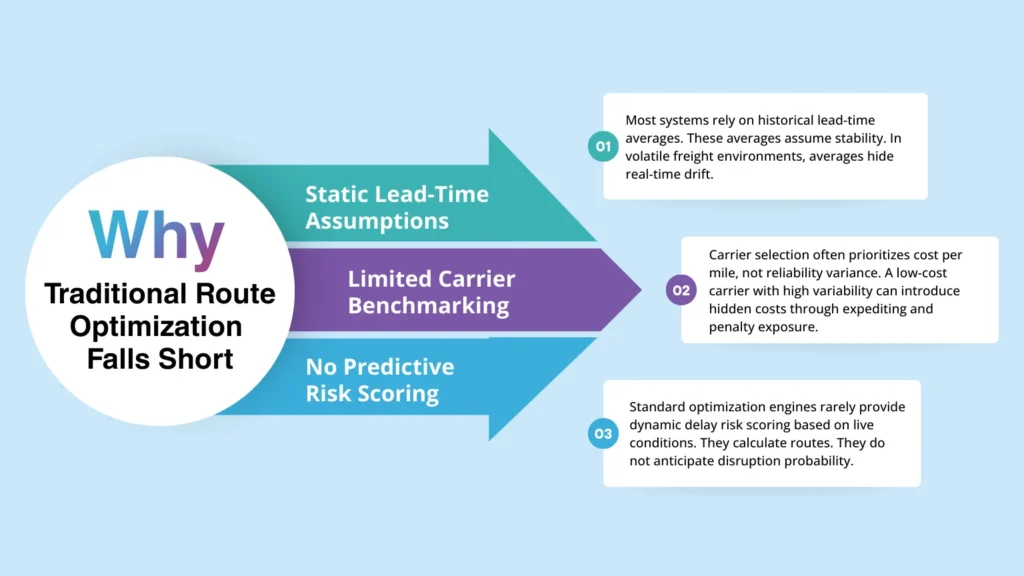
Traditional logistics systems optimize for the shortest path, the lowest cost route, and pre-defined constraints. However, modern logistics volatility is rarely driven solely by distance. It is driven by variability in carrier performance, port congestion, border delays, weather anomalies, capacity bottlenecks, and regulatory inspections.
When variability increases, even the most optimized route fails to deliver predictably. This leads to late OTIF penalties, expedited freight, customer dissatisfaction, reactive re-planning, and higher upstream buffer inventory.
According to studies, companies with limited supply chain visibility experienced 2–3x more disruption-related cost exposure during recent volatility cycles. The issue is not route length; it is signal timing.
The Operational Impact of ETA Variance
Traditional systems update ETAs after the delay becomes visible. By then, response options are limited.
ETA accuracy directly influences production scheduling, warehouse staffing, retail shelf replenishment, cold-chain integrity in F&B, and compliance exposure in pharma. Even small ETA deviations compound downstream.
For example:
Refrigerated freight (F&B)
A small 6-hour delay in a refrigerated trailer’s arrival at a cross-dock can push product beyond its optimal temperature exposure window. Industry analyses estimate that 8–15% of global food loss is linked to cold-chain failures, much of it tied to timing and handling deviations rather than total transit distance.
Inbound to manufacturing
A one-day delay on a critical raw material or component can force production planners to reshuffle lines, switch to less efficient production runs, or idle labor and equipment. In surveys of manufacturers, over 40% report that unplanned delivery delays are a top-3 driver of overtime and expediting costs, even when their routing is already optimized.
Retail distribution centers and shelf availability
A delayed inbound truck into a retail DC can trigger shelf-level stockouts even when there is technically enough inventory in the broader network. Studies on on-shelf availability consistently show that 30–40% of stockouts are caused by upstream replenishment or inbound timing issues, not by true inventory shortages.
How SpectraONE Addresses Logistics Variability at the Signal Level
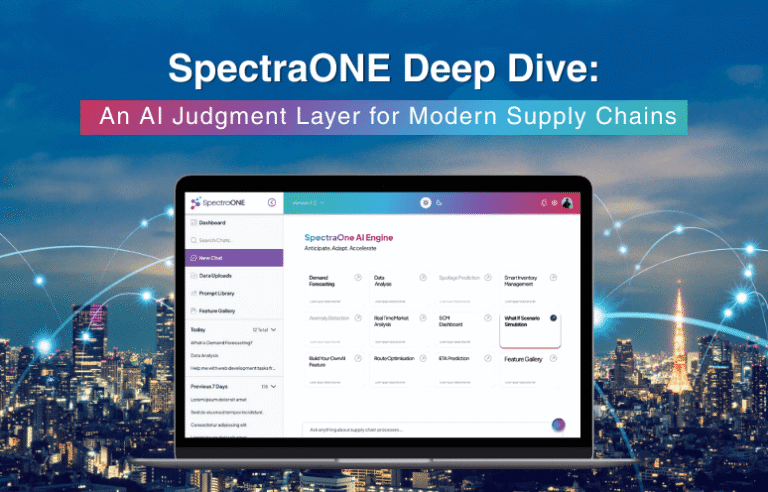
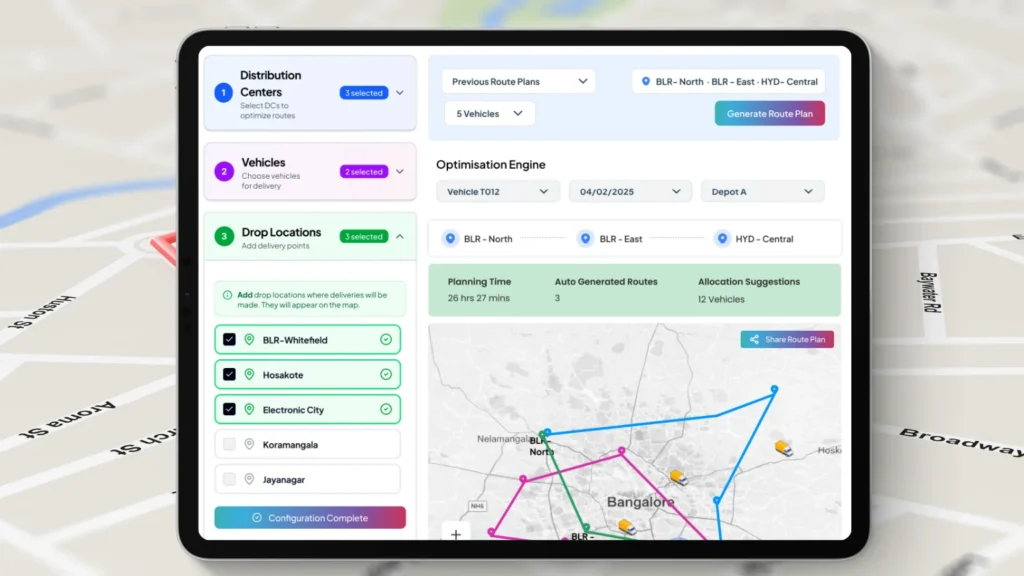
SpectraONE enhances existing TMS and ERP systems by adding a real-time intelligence layer that focuses on predictive risk and variance control. It does not replace routing engines; it strengthens decision timing.
Predictive ETA Intelligence
SpectraONE applies transformer-based pattern recognition across telemetry, carrier performance history, and contextual logistics signals.
Instead of static ETAs, teams gain dynamic variance forecasting, risk-probability scoring, and early-drift alerts. This enables proactive mitigation before delivery commitments are missed.
Carrier Performance Benchmarking Beyond Cost
SpectraONE analyzes carrier variability patterns, not just rate structures. Teams can evaluate historical delay frequency, lane-level volatility, and seasonal performance deviations. This allows selection decisions based on reliability, not only price.
Real-Time Risk and Exception Monitoring
Rather than waiting for shipment status changes, SpectraONE surfaces early warning signals tied to route congestion indicators, external market shifts and regional disruption patterns. This early signal awareness reduces the need for reactive expediting.
What Changes After Implementation
Logistics and 3PL operators typically observe:
- Improved ETA reliability
- Reduced last-minute expediting
- Lower penalty exposure
- Better alignment between inbound and production schedules
More importantly, planning teams begin making routing decisions based on predicted risk rather than post-event reporting.
The Strategic Shift
From Route Optimization to Variance Control
| Traditional model Optimize distance → React to delay. | Signal-driven model Predict variability → Adjust before delay. |
This shift impacts transportation cost stability, service-level reliability, cold-chain integrity, and network resilience. In volatile freight environments, variance control is more financially significant than marginal distance savings.
Test ETA Variance Control in 14 Days
No replacement of your TMS | No disruption to current workflows | No integration overhaul
If your logistics team is optimizing routes but still absorbing unpredictable delivery shifts, the missing element may not be routing efficiency. It may be predictive signal intelligence.
The SpectraONE 14-Day KPI Challenge enables you to select one KPI (ETA Accuracy, Expedite Rate, OTIF), analyze real shipment data in a controlled environment, and measure variance visibility improvements.
Select one KPI and run the 14-day evaluation. Measure whether predictive visibility reduces variability cost. |