The 2026 Bullwhip: Why Agentic AI is the Final “Shock Absorber” for Supply Chains

In supply chain circles, the “Bullwhip Effect” is often treated like the weather, something we talk about constantly but assume we cannot control. Historically, a 5% swing in retail demand has reliably translated into a 40% panic at the manufacturing plant.
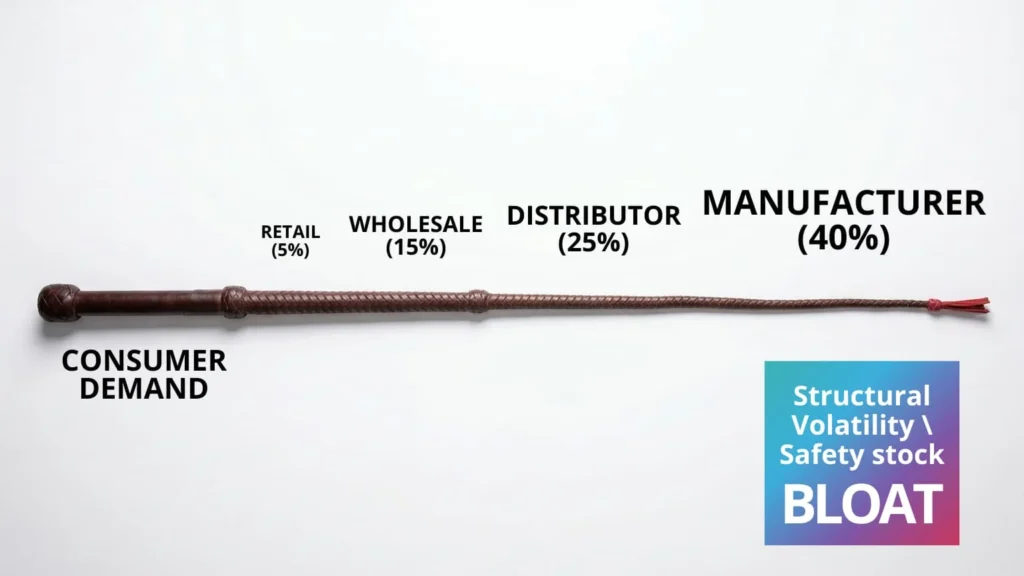
Despite the digital transformation of the 2010s, this phenomenon has only intensified in 2026 as consumer behavior becomes more fragmented across social and digital channels.
At SpectraONE, we have observed that while companies have better data than ever, the bullwhip is actually a reasoning problem, not just a data problem. Here is how we are using LLM-based Agentic AI to finally dampen the whip.
The “Information Echo” Problem
The bullwhip effect is essentially a global game of “telephone.” Let’s understand this with an example.
Imagine a viral social media trend suddenly triples the demand for a specific oat milk brand in the US Midwest.

To a local grocer, it’s a one-week stockout. But as that signal travels upstream (unverified and lacking context) the distributor 2X their safety stock, and the processing plant authorizes a massive new production run.
By the time the extra inventory arrives next month, the trend will have vanished, leaving the manufacturer with a warehouse full of expiring goods.
Traditional ERP and APS (Advanced Planning and Scheduling) systems actually worsen this. They are programmed with static safety stock formulas that react to historical variance. As we noted in our recent deep dive on Safety Stock Bloat, this leads to a quiet expansion of working capital that kills margins.
The Human vs. The Agent: Two Different Worlds
In 2026, the differentiator isn’t how much data you have; it’s how quickly you can reason through it.
1. The Human Planner: The “Hedge and Hope” Strategy
When a human planner sees a disruption, let’s say an ETA delay at a major port, their natural instinct is to over-correct. They lack the cognitive capacity to instantly calculate the downstream impact on 500 different SKUs across 12 distribution centers.
They manually increase the next three Purchase Orders (POs) by 15% “just in case.” So, the result is that this localized “safety” creates a massive inventory glut four months later when the port clears.
2. SpectraONE’s Agentic AI: The “Orchestrated Dampening” Strategy
An LLM-based agent doesn’t just look at a spreadsheet; it uses stochastic reasoning to understand the context of the signal. Our agents are built on a Multi-Agent System (MAS) architecture that functions like a digital brain. It breaks down the problem through multi-step reasoning.
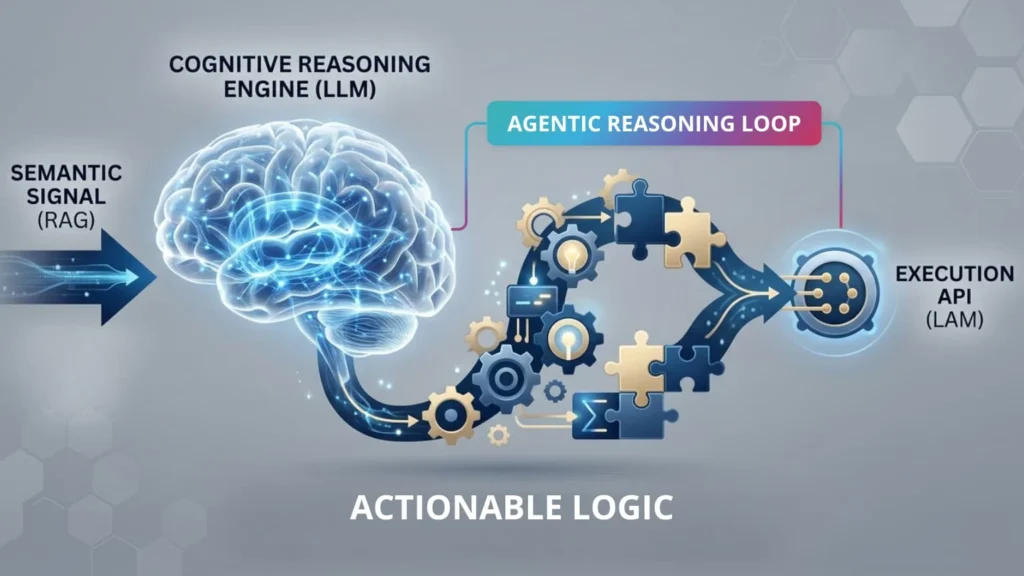
The Sensing Agent: Detects a 10% lift in a specific region using multi-feature signals (weather, social sentiment, and local holidays).
The Reasoning Agent: Uses context-aware logic to ask: “Is this lift a trend or a fluke?” It cross-references the lift with recent promotion breakdowns to determine whether demand is cannibalized from a future week.
The Execution Agent: Instead of ordering 15% more for everyone, it autonomously negotiates a “micro-shift” in existing stock between two regional DCs and prepares the trigger for the ERP.
Technical Depth: Context-Aware Decision Support
A common misconception is that Large Language Models (LLMs) are being asked to solve the math of the supply chain. In the SpectraONE architecture, the LLM isn’t the calculator; it’s the Contextual Interpreter.
We have unified Retrieval-Augmented Generation (RAG), Digital Twins, and Optimization Engines into a single cohesive narrative:
- Context (LLM and RAG): The system “reads” the context of a disruption (e.g., a news report on a regional carrier strike).
- Simulation (Digital Twin): The agents ask the Digital Twin, “What is the projected impact if this specific node is delayed by 72 hours?”
- Calculation (Optimization Engine): The engine computes the numerical adjustments needed to maintain service levels.
SpectraONE agents can explain why they are dampening a signal. This “Explainable AI” is critical; according to 2026 industry benchmarks, 74% of AI implementations fail because planners don’t trust the “black box” (Source: SpectraONE – Why Most AI Tools Fail).
SpectraONE provides a business-ready narrative: “I am recommending no increase to the PO because the current demand spike is highly correlated with a 3-day heatwave, not a structural shift in consumer preference.”
The Financial Impact: By the Numbers
The shift from reactive planning to agentic orchestration has measurable ROI. Recent 2025/2026 case studies in the FMCG and Retail sectors show that dampening the bullwhip via Agentic AI leads to:
Reduction in Excess Inventory by eliminating the “just in case” manual overrides that plague human planners.
Improvement in OTIF (On-Time In-Full) by sensing shortages 7–10 days earlier than traditional ERP systems (Source: Logistics Management 2026 Trends).
Reduction in Expedited Shipping Costs because the “panic” phase of the bullwhip is caught at the source, preventing the need for last-minute, high-cost logistics.
Moving to “Signal-to-Action” Parity
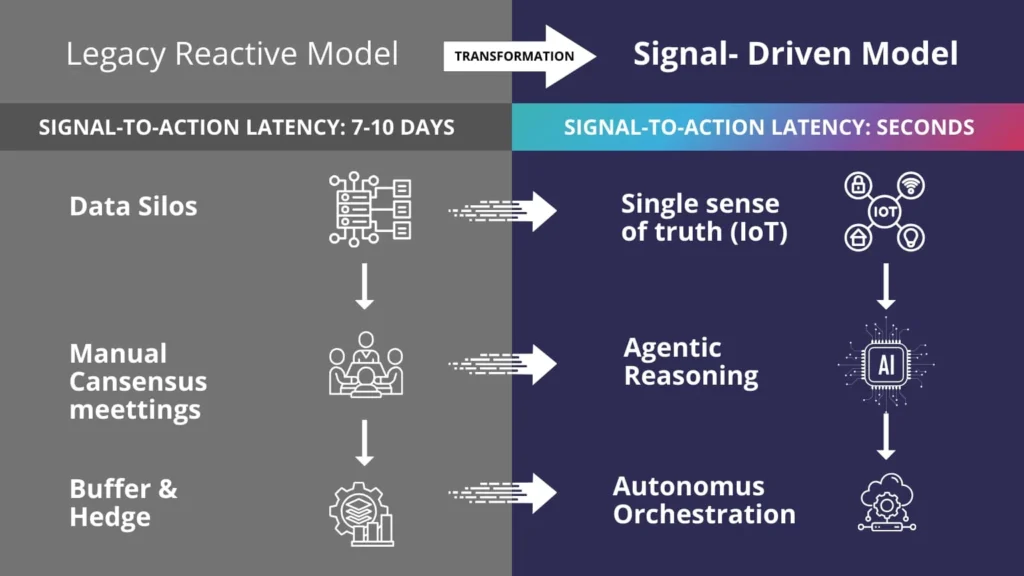
In 2026, the goal of a world-class supply chain is to achieve Signal-to-Action Parity. It means the moment a product is scanned at a retail checkout, the entire upstream supply chain from the DC to the raw material provider adjusts its expectations in unison.
SpectraONE’s SKU-Location forecasting ensures that this signal is accurate at the most granular level, while our agentic layer ensures that the reaction to that signal is measured, logical, and profitable.
Conclusion
The bullwhip effect is not an inevitability; it is a symptom of disconnected reasoning. While traditional tools gave us the data to see the wave coming, SpectraONE’s Agentic AI gives you the power to break the wave before it hits the factory floor. It is an Operational Intelligence and Execution system.
We provide the brain that interprets the signal and the framework to execute the response. As we look toward the remainder of 2026, the market winners will be the companies that stop fighting the bullwhip and start dampening it through autonomous, intelligent orchestration.