SpectraONE Deep Dive: An AI Judgment Layer for Modern Supply Chains
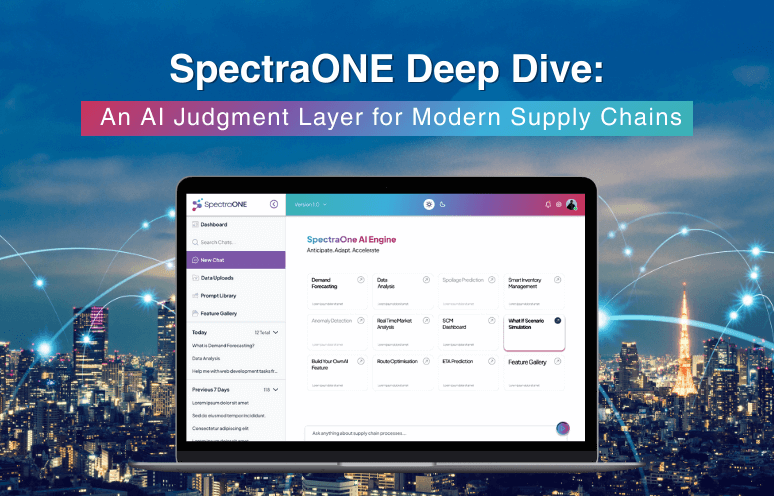
Our public launch of SpectraONE is now live on Business Wire. That announcement covers the “what” an AI-driven supply chain platform can do and how it helps teams move from reactive firefighting to predictive planning without ripping out their core systems.
This post is about the “how” and the “why” behind it. Because the real bottleneck in supply chains today isn’t dashboards or data.
It’s judgment.
The Real Bottleneck: Judgment, Not Data

Most teams we talk to already have:
- An ERP that runs orders, inventory, and invoices
- WMS / TMS that know where goods are and how they move
- Planning tools and a forest of BI dashboards
Yet every week, leaders still end up in the same meetings:
- Reacting to late shipments, demand spikes, or supply shocks
- Reconciling different reports that “don’t quite match”
- Debating which SKUs, lanes, or suppliers deserve attention right now
They’re not short of information.
They’re short of a system that can look across all of it and say:
“Given everything happening in demand, inventory, and risk…
Here are the 10 moves that protect service and optimize working capital.”
That “thinking before action” is the judgment layer.
It’s mostly done by a handful of overstretched planners and operations leaders.SpectraONE exists to augment that layer, not replace it.
Where SpectraONE Sits in Your Stack
SpectraONE is not another system of record. It’s the AI brain that lives on top of what you already have.
Think of your stack in three layers:
- Judgment – decisions on what to buy, move, expedite, rebalance, or protect
- Execution – ERP, WMS, TMS, planning tools
- Reporting – BI dashboards, static reports
SpectraONE is deliberately built for layer 3:
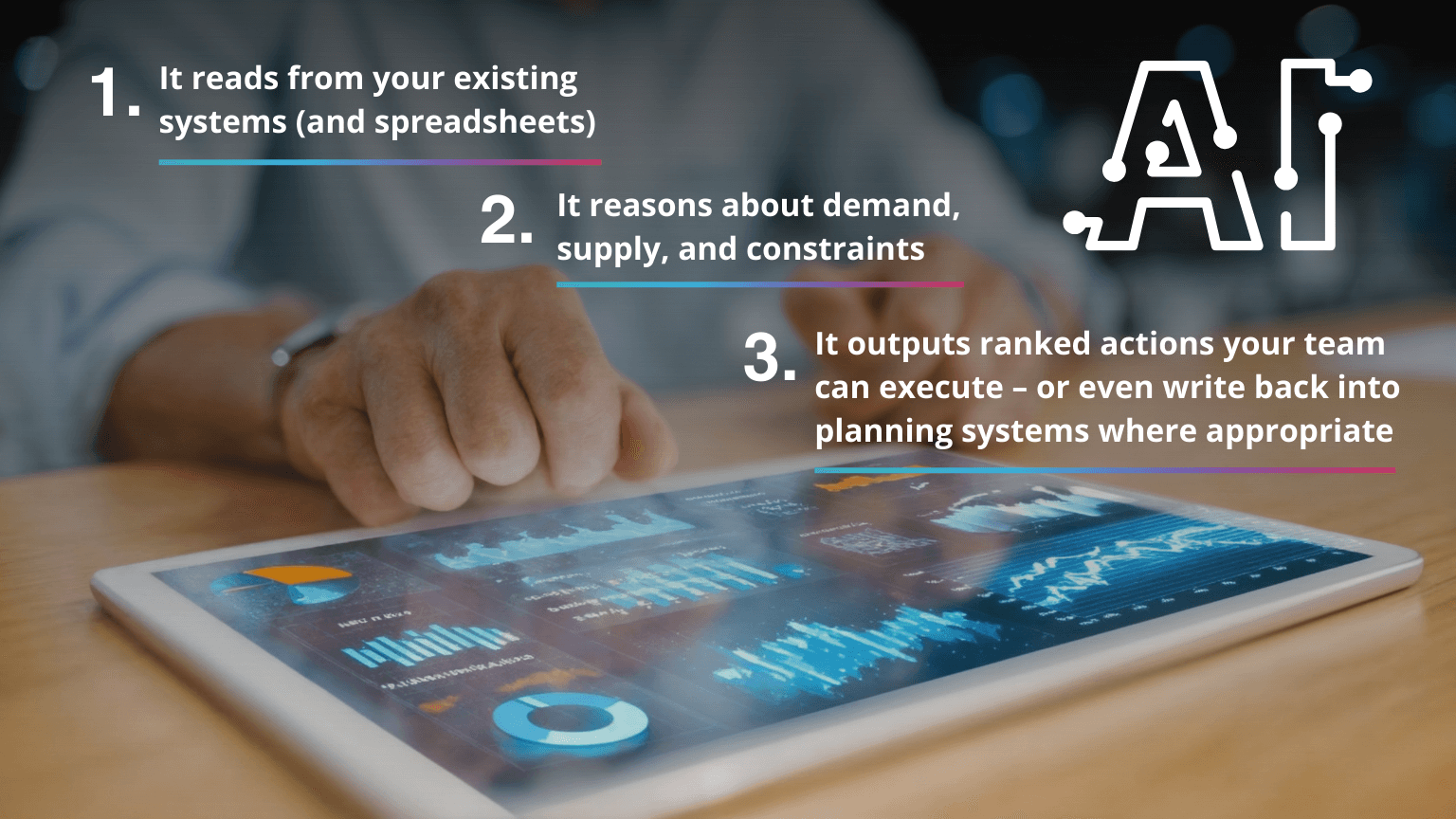
- It reads from your existing systems (and spreadsheets)
- It reasons about demand, supply, and constraints
- It outputs ranked actions your team can execute – or even write back into planning systems where appropriate
We’re not trying to be a new ERP. We’re trying to be the judgment engine that makes the ERP smarter.
What SpectraONE Actually Does
In practice, teams use SpectraONE to answer questions like:
- “Where are we most exposed to stockouts in the next 4-8 weeks?”
- “Which SKUs are overstocked, and where can we safely rebalance?”
- “If lead times slip 10-15% on this lane, what happens to OTIF, and what can we do now?”
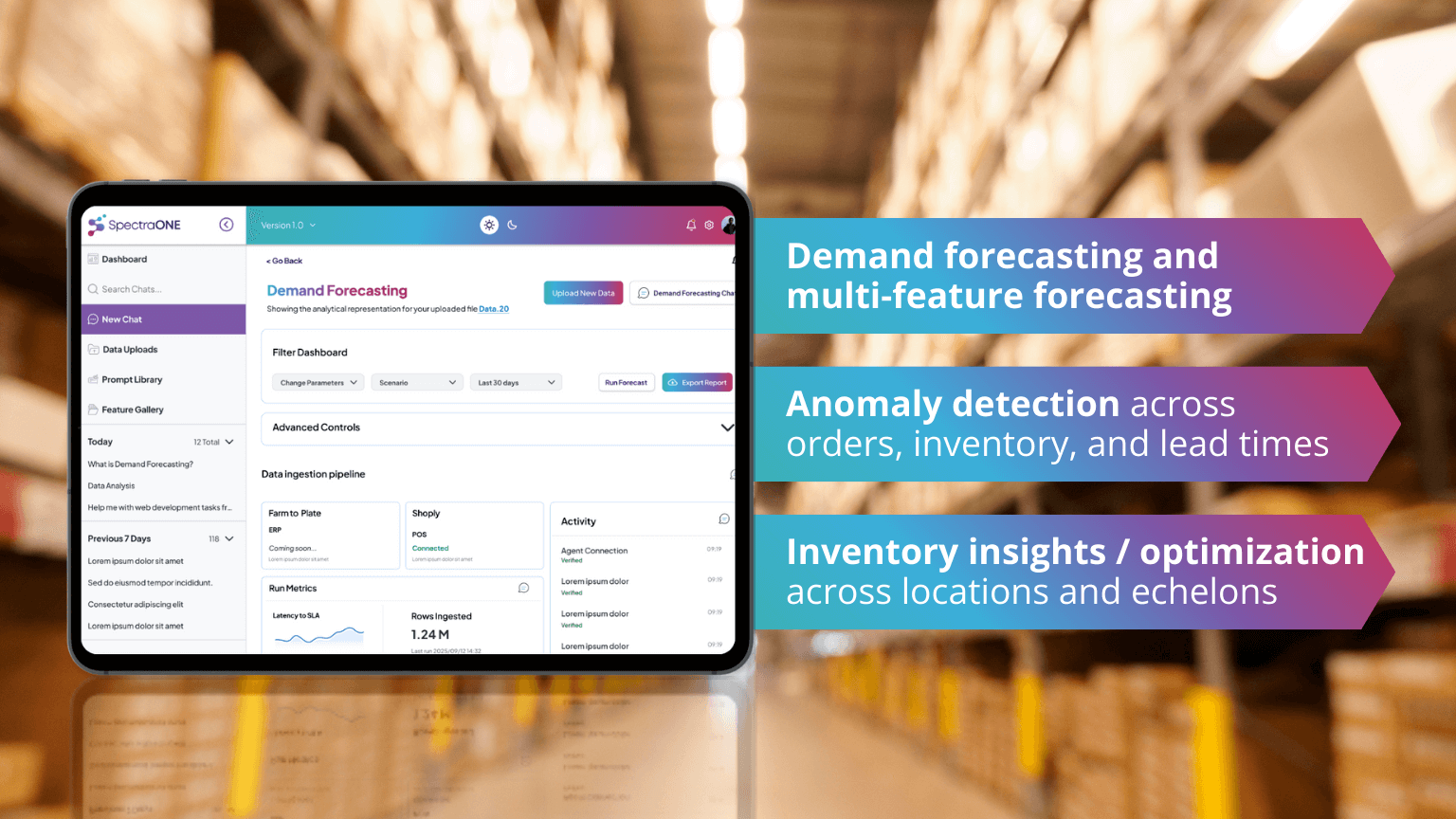
Under the hood, the platform combines:
- Demand forecasting and multi-feature forecasting
- Anomaly detection across orders, inventory, and lead times
- Inventory insights/optimization across locations and echelons
But the product is not “a bunch of models.”
The product is the decision it helps you make and the chain of reasoning behind it.
How SpectraONE Thinks: From Question → Context → Reasoning → Actions

SpectraONE works more like a strategist than a report generator.
1. Start with the question
Everything starts with a concrete problem:
“Reduce stockouts on high-margin SKUs in Region X without blowing up inventory.“
The platform uses LLMs tuned for supply chain language and workflows to unpack that question into:
- What data is needed
- Which constraints matter
- What “good” looks like for that decision (service, cost, risk)
2. Ingest reality as it is
SpectraONE then pulls the latest state of your network via an adapter-first ingestion layer that connects to:
- ERP (SAP, Oracle, Dynamics, etc.)
- WMS / TMS
- Planning tools
- External feeds and structured files (CSVs, spreadsheets)
It’s expressly designed to work with imperfect, real-world data – not just pristine data lakes – so teams can see value without a year of cleanup first.
3. Run parallel analysis across demand, supply, and risk
Instead of one monolithic model, SpectraONE spins up parallel analytical threads:
- Demand projections under different assumptions
- Supply and capacity risks across suppliers, plants, and lanes
- Inventory imbalances and rebalancing opportunities
- Sensitivity around service-level targets and working capital
Each thread brings a different lens to the same problem.
4. Reason about trade-offs
This is where the judgment layer kicks in:
- What’s the smallest set of moves that removes the biggest risk?
- How do we protect service without locking up too much capital?
- Which suppliers or lanes are single points of failure?
SpectraONE uses reasoning capabilities from transformer models and LLMs aligned with supply chain objectives to evaluate scenarios and score trade-offs instead of just spitting out raw numbers.
5. Deliver an action plan you can execute
Finally, the system compiles a ranked list of recommended actions, for example:
- Expedite or re-sequence these specific POs
- Rebalance these SKUs between locations to protect OTIF
- Adjust safety stock or order quantities on this subset of items
Each recommendation comes with:
- The “why” (what changed, what it’s protecting)
- The impact (on service, cost, and risk)
- The assumptions behind the suggestion
You’re not staring at another dashboard.
You’re reviewing a decision memo that your team can challenge, approve, and execute.
Built for Trust: Explainability, Privacy, and Independence

Explainability
If a system is a black box, planners will rightly ignore it.
SpectraONE is built to be auditable:
- You can see which signals drove a recommendation
- You can inspect assumptions and sensitivities
- You can ask “what changed since last week?” and get an answer you can follow
Privacy-first architecture
SpectraONE was designed from day one with isolated, per-customer environments:
- No cross-client data pooling
- Clear boundaries between your data and other customers’ data
- An architecture that supports the privacy and regulatory expectations of industries like retail, F&B, pharma, healthcare, and logistics
The models get smarter in how they reason about decisions, but your underlying data stays yours.
Who SpectraONE Is For and How to Judge It

SpectraONE is built for teams that live where demand, supply, and risk collide:
- VPs / Heads of Supply Chain & Operations
- Leaders in Planning, S&OP / IBP, and Logistics
- Category, inventory, and network planning teams
The right way to evaluate it isn’t “does the demo look cool?”
It’s:
- Did we see fewer stockouts in the pilot scope?
- Did we improve forecast accuracy on the SKUs that matter most?
- Did we improve working capital while holding or improving service levels?
That’s why we built the go-to-market motion around focused pilots, not open-ended projects.
Join the 30-Day SpectraONE Pilot
To coincide with the launch, we’re opening a limited 30-day pilot program for a small number of companies.
How it works:
- Pick one KPI – e.g., stockouts, OTIF, or working capital on a defined portfolio.
- Connect SpectraONE to the minimum viable slice of your stack (ERP + one or two operational systems).
- Run a 30-day cycle where the system surfaces weekly action plans, and we measure impact.
During the pilot, you get:
- A dedicated solution engineer and customer success lead
- Weekly working sessions to tune recommendations with your planners
A simple before/after impact summary you can take to your leadership team
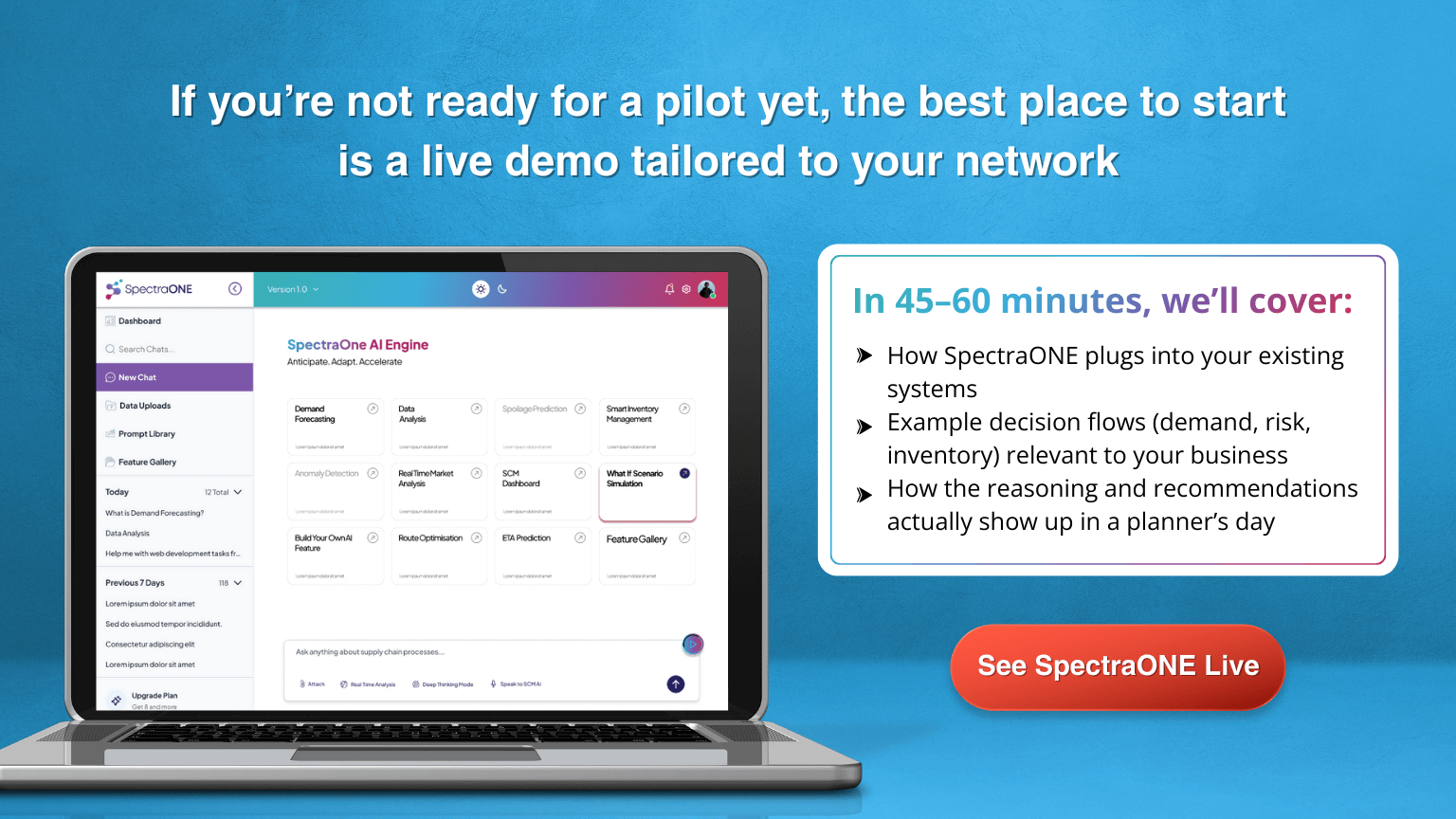
You don’t need another dashboard.
You need a judgment layer that understands your constraints, reasons across your network, and hands your team a better set of moves every week.
That’s the job description for SpectraONE, and this launch is just day one.