
Safety Stock Bloat in Retail and FMCG: Why Working Capital Is Quietly Expanding

The Structural Shift in Demand Volatility Across North America
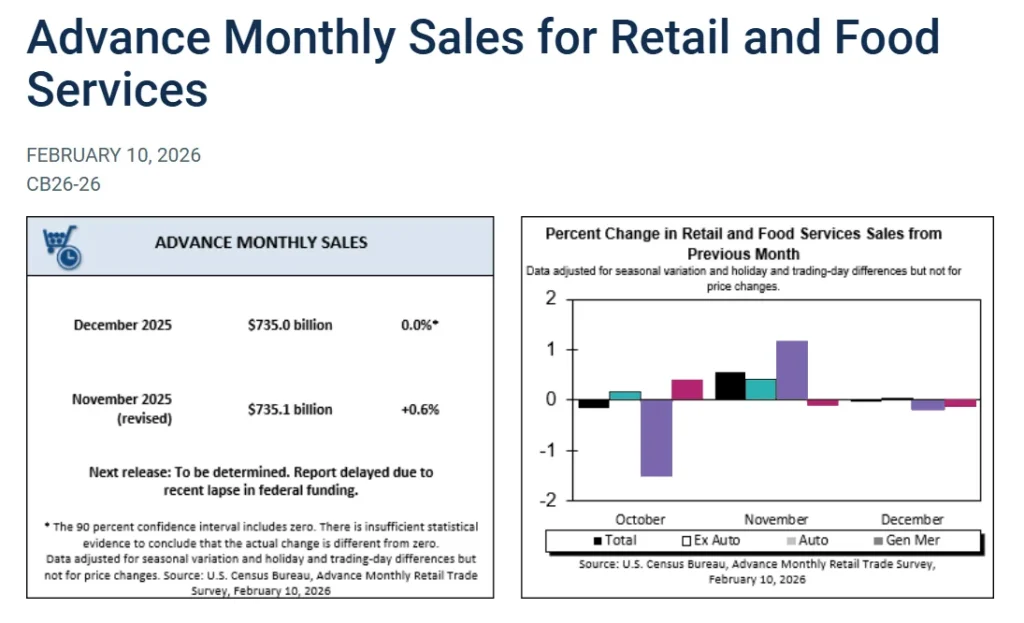
Over the past five years, supply chains across North America have entered a structurally volatile environment. Retail sales alone exceed $700 billion per month in the United States (U.S. Census Bureau). At that scale, even small variations in demand patterns have a measurable financial impact.
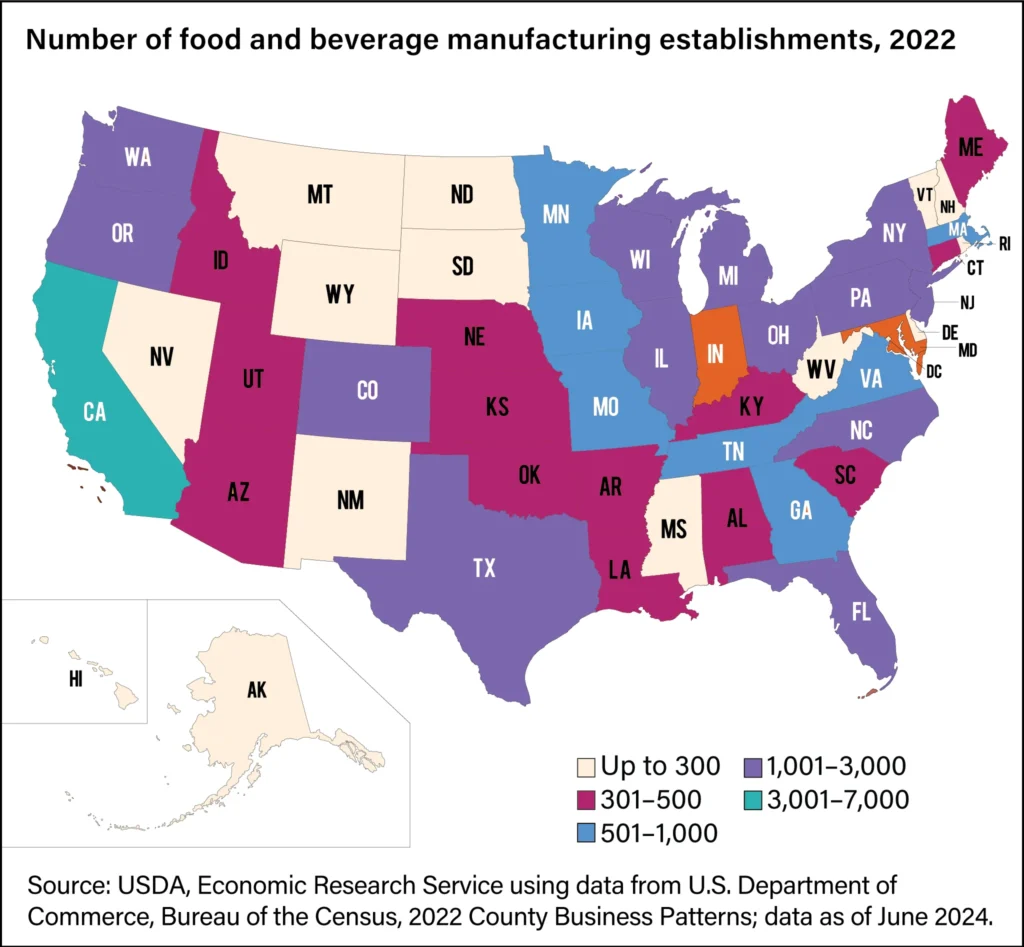
Simultaneously, food and beverage manufacturers operate in a market comprising more than 42,000 facilities across the U.S. (USDA ERS). These networks are managing shorter product lifecycles, faster promotional cycles, and higher customer expectations.
According to McKinsey, 82% of supply chains report experiencing disruptions linked to trade or geopolitical volatility. These disruptions amplify lead-time uncertainty and demand variability.
In response, most organizations have adopted a defensive posture and increased safety stock. While this reaction feels prudent, it often masks a deeper structural issue.
Why Safety Stock Levels Continue to Rise
A safety stock is designed to protect service levels as variability increases. However, in today’s environment, three structural factors are quietly inflating buffer levels.
1. Delayed Detection of Demand Drift
Traditional planning systems rely on historical variance and periodic recalculation cycles. Demand deviations are recognized only after sufficient historical data accumulates to make the shift statistically visible.
By the time a deviation is formally recognized, replenishment cycles have already been executed, production completed, and transfers scheduled. The common response in the next cycle is to increase buffer levels to avoid recurrence. This reactive adjustment compounds over time.
2. Node-Level Imbalance in Retail Networks
Retail inventory often appears balanced at an aggregate level. However, imbalance frequently develops at indivRetail inventory often appears balanced at an aggregate level. However, imbalance frequently develops at individual stores, distribution centers, or regional clusters. When demand shifts unevenly across nodes, some locations accumulate excess inventory, others experience stock pressure, and redistribution occurs too late to prevent margin erosion.
Without real-time visibility into node-level drift, organizations compensate by raising overall safety stock, even though the root problem is distribution misalignment rather than total demand insufficiency.
3. Manual Override Amplification
InIn volatile environments, planners often override system-generated forecasts to reduce perceived risk. While overrides are sometimes necessary, they introduce bias into subsequent planning cycles. Over time, overrides become embedded assumptions, forecast variability appears artificially elevated, and safety stock calculations lead to further buffer inflation.
This cycle is rarely reversed once it becomes embedded in the planning process.
The Financial Implications of Safety Stock Bloat
Excess safety stock impacts far more than warehouse space. It directly influences, working capital allocation, inventory carrying costs, markdown exposure, obsolescence risk and sash flow flexibility.
The Institute of Business Forecasting notes that improving forecast accuracy by 10–20% can significantly reduce inventory levels and associated carrying costs. However, improving forecast accuracy alone does not resolve the timing issue that drives buffer inflation. The critical factor is not only accuracy, but also signal timing.
How SpectraONE Reduces Safety Stock Without Increasing Stockout Risk
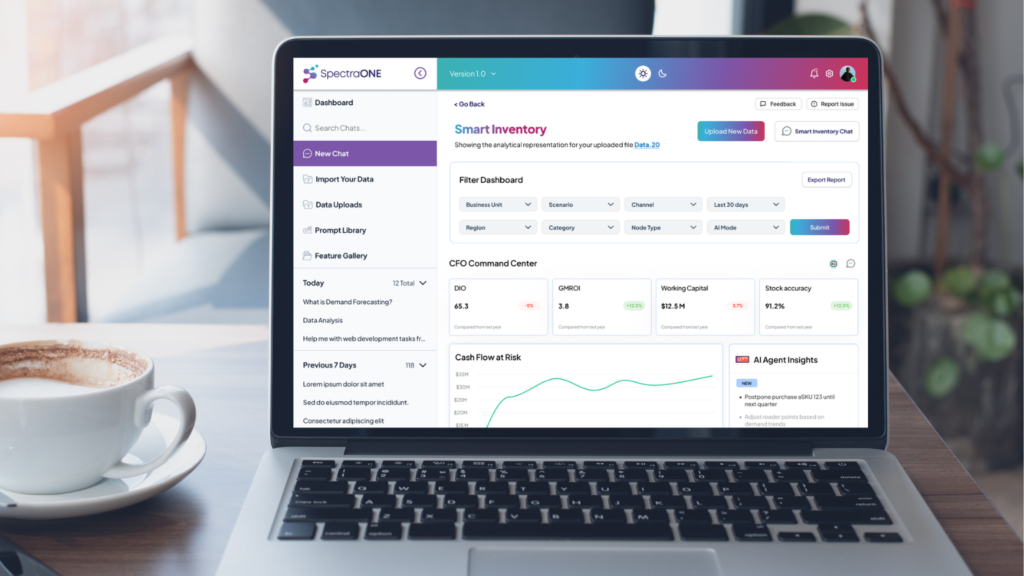
SpectraONE does not replace ERP, forecasting, or replenishment systems. Instead, it introduces a real-time signal intelligence layer that enhances the timing and quality of operational insight. The measurable difference lies in how volatility is detected and interpreted.
Early Drift Detection Before Variance Becomes Structural
SpectraONE applies transformer-based pattern recognition and contextual reasoning to structured operational data. Rather than waiting for deviations to accumulate across planning cycles, it identifies unusual drift as it begins to form.
This earlier detection allows teams to adjust replenishment before the imbalance widens, reallocate inventory before shortages intensify, and modify procurement plans before excess builds. By acting sooner, organizations reduce the need to increase safety stock defensively.
Node-Level Visibility Across Retail and FMCG Networks
In retail and FMCG environments, performance distortion rarely appears uniformly. SpectraONE surfaces node-level variations in demand and supply, enabling planners to understand where imbalances are developing.
Instead of raising network-wide buffers, teams can target specific nodes for redistribution, protect high-risk clusters without inflating global stock, and maintain service levels with lower overall inventory exposure. This precision reduces working capital strain while maintaining customer satisfaction.
Scenario Simulation Before Buffer Expansion
SSafety stock increases are often implemented without structured scenario evaluation. SpectraONE enables operational teams to simulate sustained demand drift, lead-time normalization, promotion extension effects, and supply-side variability.
Rather than adjusting buffers based on uncertainty, planners can test potential outcomes before committing capital.
Reducing Manual Override Dependency Through Explainable Insight
SpectraONE provides contextual explanations behind detected anomalies. By identifying likely drivers such as regional lift patterns or correlated supply shifts, planners gain greater confidence in system-generated insight. Improved trust reduces unnecessary overrides, which in turn stabilizes future safety stock calculations.
What Changes Operationally After Implementation
Organizations implementing SpectraONE typically observe:
- Reduced reactive buffer adjustments
- Clearer node-level visibility
- Improved alignment between forecasting and replenishment
- Greater confidence in lowering safety stock in stable clusters
The transformation is not abstract; it is operational. Safety stock becomes a deliberate decision variable rather than a reflexive protection mechanism.
Moving From Buffer Management to Signal Management
The fundamental shift in modern supply chain planning is not eliminating safety stock. It is managing it intelligently.
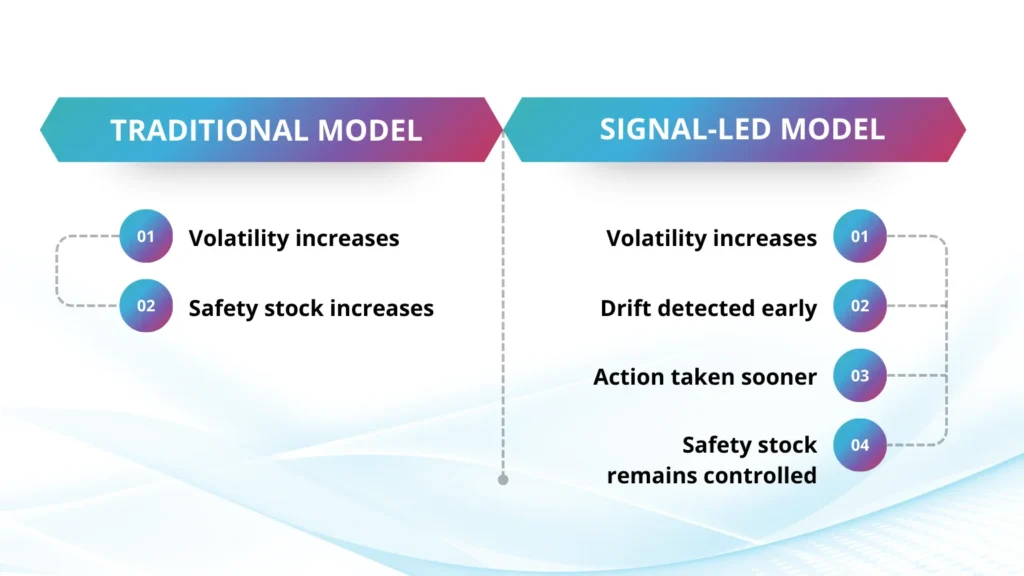
This distinction directly impacts margin, working capital, and inventory turns.
Test the Impact Before You Commit
If safety stock has steadily increased in your organization over the past several years, the most important question is not whether volatility exists. It is whether your systems detect that volatility early enough to avoid defensive over-buffering.
The SpectraONE 14-Day KPI Challenge enables you to select one KPI (Inventory Turns, Forecast Accuracy, Stockout Rate), run a structured 14-day signal analysis, and measure whether earlier visibility reduces buffer dependence.
No system replacement | No integration risk | No workflow disruption. Choose one KPI and test it for 14 days. Measure the operational difference before scaling. |