AI Supply Chain APAC: Turning Regional Complexity into Predictable Performance
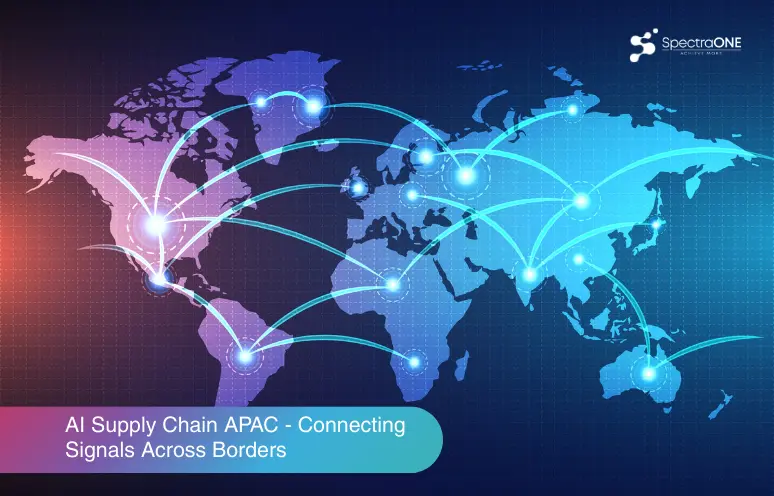
The Asia-Pacific region is one of the most complex supply chain environments in the world. Production may sit in one country, suppliers in another, and demand scattered across several fast-moving markets. Add currency shifts, port congestion, regulatory variation, and promotional volatility, and even well-run networks can feel fragile.
This is why conversations around AI supply chain APAC adoption are becoming more practical and less theoretical.
Leaders aren’t asking whether AI sounds innovative. They’re asking whether it helps them avoid the next disruption.
The Reality of APAC Supply Networks
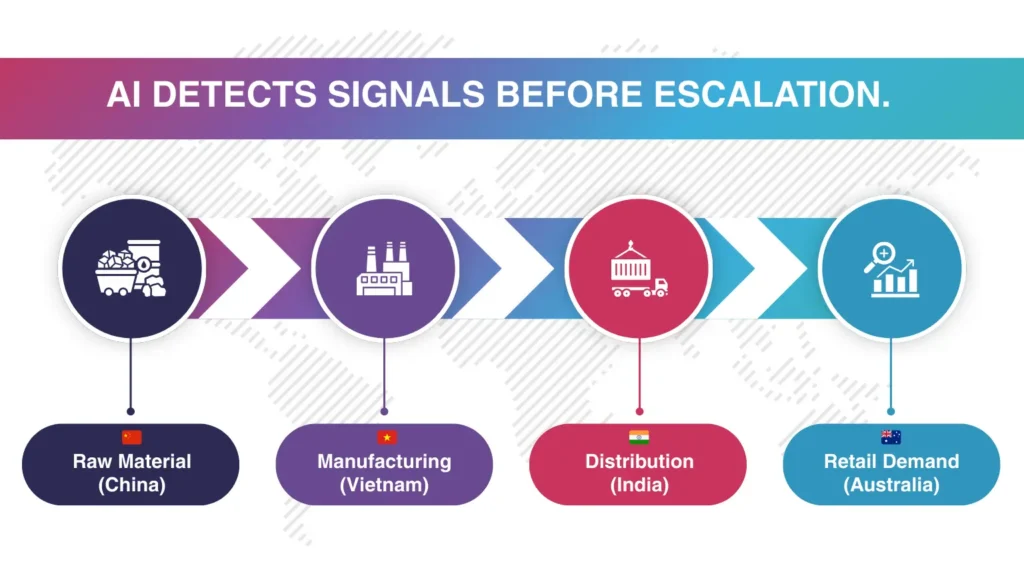
APAC supply chains are deeply interconnected. A raw material delay in China can quietly affect manufacturing in Vietnam. A demand spike in India can distort regional inventory planning. Often, the signals appear small at first — a slight increase in order frequency, a minor lead-time stretch, a subtle shift in channel mix.
Traditional systems capture the data. They just don’t always connect it early enough.
Most enterprises already have ERP systems, reporting dashboards, and planning tools. The issue isn’t visibility. It’s an interpretation. By the time risks are obvious in reports, they’ve usually already impacted service levels or working capital.
AI supply chain APAC strategies focus on identifying these early patterns — before they become operational emergencies.
Why Forecasting Alone Isn’t Enough
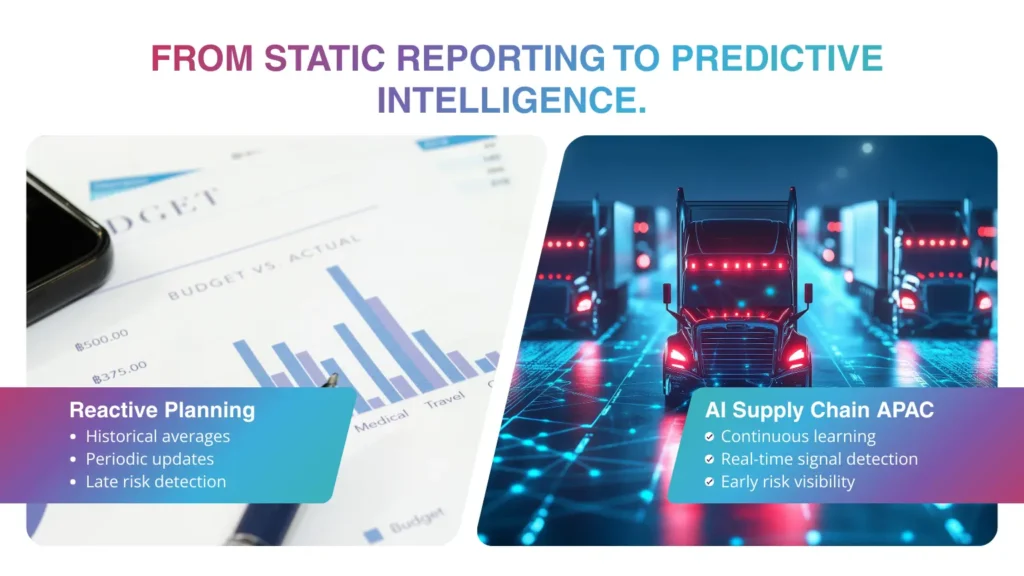
Forecasting is often where improvement begins. In many APAC markets, demand patterns don’t behave consistently year over year. Growth can be sharp but uneven. Promotions distort baseline trends. Urban consumption shifts quickly. Relying purely on historical averages creates instability.
AI-driven forecasting models learn continuously. They adjust as patterns shift instead of waiting for the next planning cycle. Over time, this reduces the gap between planned and actual demand. But forecasting is only one part of the equation.
AI supply chain APAC platforms extend beyond demand numbers. They correlate supply variability, production constraints, and logistics performance. When signals move in different parts of the network, AI can surface connections that manual reviews might miss.
This changes how teams respond. Instead of reacting to shortages, they anticipate them. Instead of expediting shipments, they rebalance earlier.
Cross-Border Complexity Requires Connected Intelligence
One defining characteristic of APAC operations is geographic spread. Few enterprises operate within a single national boundary. Most manage multi-country networks, each with its own regulatory requirements and infrastructure reliability.
Without connected intelligence, planning becomes siloed. Regional teams optimize locally, sometimes at the expense of the broader network.
AI supply chain APAC solutions create a unified analytical layer. They help organizations see how decisions in one country influence performance in another. This improves coordination and reduces unintended ripple effects.
For enterprises managing multiple markets simultaneously, this broader perspective is critical.
Trust and Explainability Matter
Adopting AI in enterprise environments is not just about model accuracy. It is about trust.
Planners and operations leaders need to understand why a system is recommending a change. If the logic is opaque, resistance follows.
Explainable AI addresses this directly. When a forecast shifts, the system should indicate what’s driving it, whether it’s order frequency, supply delays, or channel variation. Confidence indicators help teams judge how aggressively to respond.
In APAC organizations, where decisions often involve multiple stakeholders, clarity speeds alignment.
AI supply chain APAC transformation works best when it supports human judgment rather than attempting to replace it.
Where SpectraONE Comes In
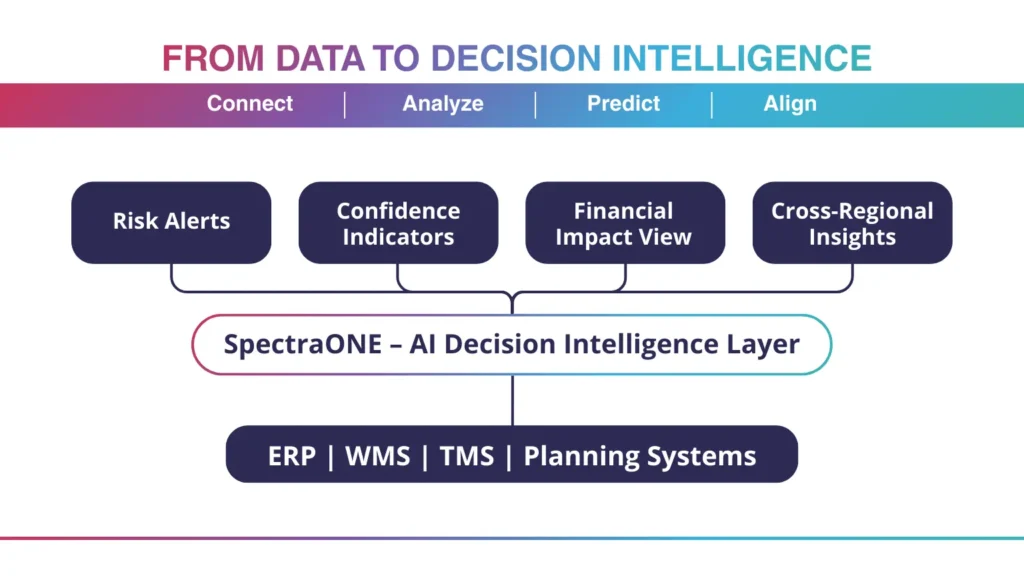
SpectraONE supports enterprises pursuing AI supply chain APAC initiatives by acting as a decision intelligence layer across existing systems.
Instead of replacing ERP or planning tools, SpectraONE connects demand, supply, inventory, production, and logistics signals into one continuous analytical view. It monitors patterns, flags emerging risks, and provides contextual insight into potential operational and financial impact.
For companies operating across multiple APAC markets, this reduces blind spots and shortens response time.
The objective isn’t to generate more data, but to bring clarity to it.
The Competitive Shift
APAC will likely remain one of the most dynamic supply chain environments globally. Growth will continue, but so will volatility.
Enterprises that depend solely on historical reporting will find themselves reacting more often than planning. Those investing in AI supply chain APAC capabilities gain a structural advantage: earlier detection, stronger coordination, and more confident execution.
In a region where small disruptions can cascade quickly, foresight becomes more valuable than hindsight.
Frequently Asked Questions
What does AI supply chain APAC mean?
It refers to the use of artificial intelligence to improve forecasting, risk detection, and operational decision-making across supply chains operating in the Asia-Pacific region.
How does AI improve supply chain resilience in APAC?
AI analyzes real-time demand and supply signals to detect emerging risks early, enabling proactive adjustments before disruptions escalate.
The objective isn’t to generate more data, but to bring clarity to it.
Yes. While large enterprises benefit significantly, mid-sized companies operating across multiple countries can also improve forecasting and inventory efficiency through AI-driven planning.